
wasting away in UTOPIA NOW!
Rosie Tucker album review

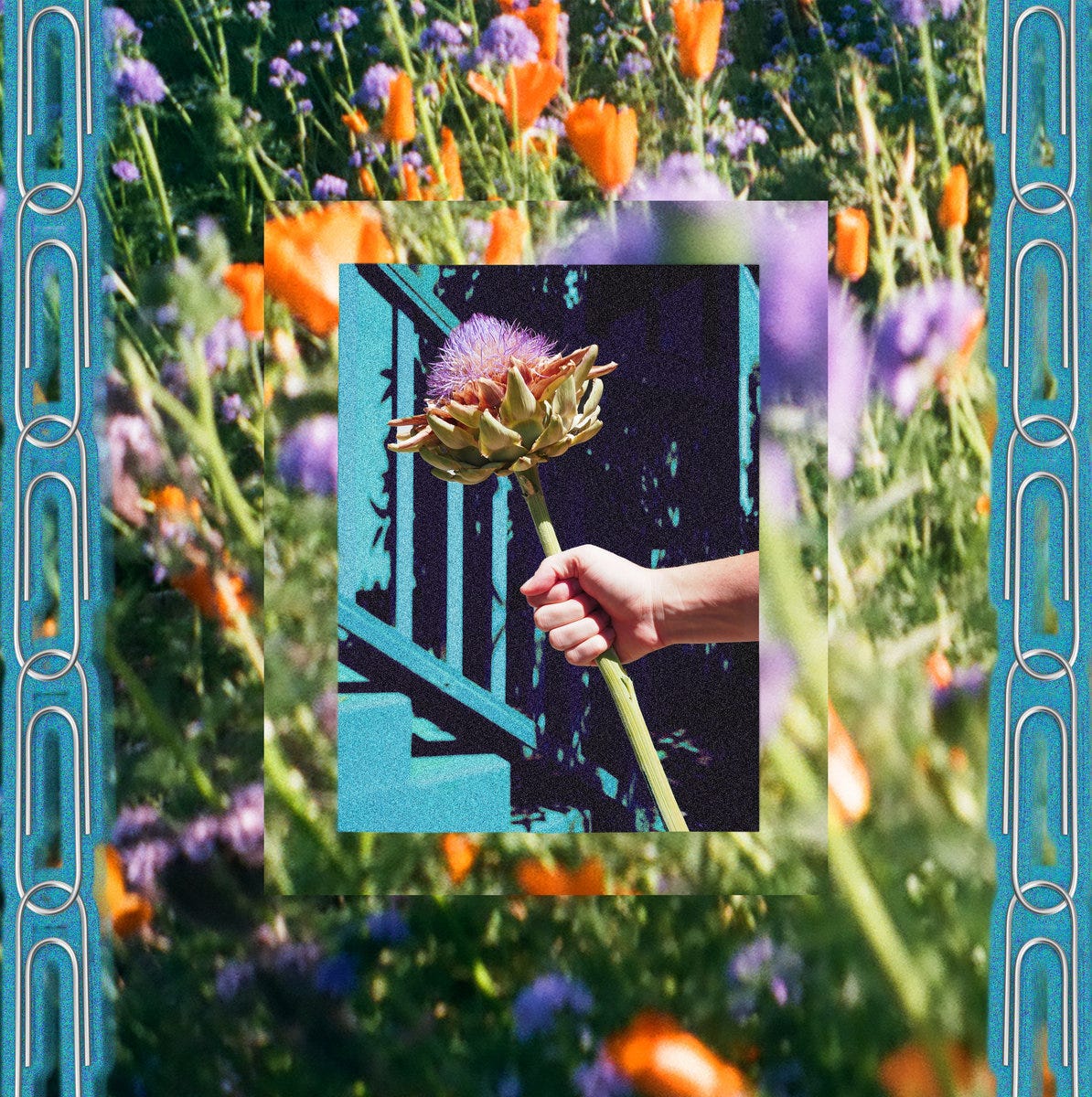
I listened to pretty much nothing but this album all of 2024.
The first single, "Unending Bliss", became a staple in a couple of my playlists. I wasn't quite as hot on "All My Exes Live In Vortexes". When "Paperclip Maximizer" dropped, I spun it a few times back-to-back, mainly to make sure I'd heard all the lyrics correctly (as they hadn't been transcribed online at that point).
The day "Big Fish/No Fun" came out, I thought, oh, I might have a problem here. I had it on loop. I never have music on loop. It goes against my nature. But apparently I listened to this one track 49 times in 2024, which is a lot for me. Something about the song just fascinated me. I couldn't get the melody out of my head, I couldn't stop thinking about it. Every single line in this song changes its meaning almost entirely, snaps the rest of it into a new lens, makes it all about something else. It's like Rubin's vase, constructed to elicit these parallel interpretations. The whole album is like this, in fact.
And I think what makes it somewhat challenging to talk about UTOPIA NOW! is that if you try to break it down into a specific lens, it's impossible to make observations which don't sound facile. Cool, so technology is bad. Fine, capitalism is destroying the planet. Wow, maybe there's some kind of love that transcends these material concerns. Gee, that other musician sure sounds like a piece of work, whoever they are, I guess.
I ended up reading and listening to every interview about UTOPIA NOW! I could find, transcribing most of the salient information onto the album’s suite of Genius lyric pages, hoping to get it out of my system, to understand it fully and move on from it. But I still don’t feel like I really get it, in its entirety, with confidence. I thought I’d write an essay about it, picking over it song-by-song, talking about what the music means to me, but in truth the existence of this paratextual material—Rosie Tucker’s own behind-the-scenes remarks, and other people’s Genius annotations—makes it tricky to tackle the album without just paraphrasing what has already been said about it. At a certain point it feels like I’m just copy/pasting lyrics and going "SO TRUE". What’s the point?
But I love this album, so what the hell.
“Lightbulb”
This is really just an introductory track, an overture, setting the stage, laying out some key motifs. The backing track is at once mechanically-annoying and ethereal, a circus-like waltz. It builds towards a more appealing sound, but is frequently faltering, stop-start.
Right off the bat, we're getting some strong wordplay that serves the track on multiple levels. Taken literally, we have this absurd personal anecdote of Tucker sitting in a dark room, waiting for an app on their phone to update so they can get their smart bulb working. But we also have this mention of this "invisible hand [of the free market]"—an economic metaphor which suggests capitalism will naturally act in the public interest. Here, the invisible hand is depicted as indolent, able only to produce waste.
The lightbulb is well-chosen as a symbol, as it's pretty much the prototypical electrical invention, ubiquitous, simple—it's farcical to think that such a device could ever undergo enshittification. This track touches on planned obsolescence: "You know that lightbulbs only die / To maximize demand". The lightbulb is also often a symbol for inspiration—"eureka!"—which plays into a second major theme, the artistic process.
On a metatextual level, "Lightbulb" sees Tucker self-interrogate over the ethical considerations surrounding the production of art under capitalism. "If you're writing the record you must want it heard / and return on investment is all but assured." The track suggests it is fundamentally impossible to disentangle the artistic process from the physical economy that facilitates it. Indeed, much of the album is concerned with the fact that it's actually impossible to disentangle these seemingly-distinct lenses from one another.
“All My Exes Live in Vortexes”
I don't know, it never really fails to crack me up how this track busts in with the line "I hope no-one had to piss in a bottle at work to get me the thing I ordered on the internet." Like, it's pathetic, isn't it? It's so resigned. The Amazon pee-bottles story dates back to 2018, blew up when Amazon acknowledged it in 2021, and has apparently continued to periodically crop up in articles that go “yep, this is definitely still a thing”. For me, this opening line gestures at the rest of an iceberg of labour exploitation, whatever injustices aren’t pervasive and shocking enough to be widely documented. We all know this stuff is happening. But we don’t always know exactly what is happening, and certainly not until it’s been happening for some time.
The feeling of thematic entanglement crops up in this track in a surprising way. The back half of the song has all these strange rephrasings of the first half, as a literal manifestation of the idea that "the memory degrades". It's like it becomes corrupted; no longer pissing in a bottle, but sipping from a bottle of piss, no longer a party, but a parting. In the closing refrain, the impossibility of achieving a clean conscience is made quite clear: "pull the plastic from the food stuff". How can we? Like fossils, we too are turning to plastic, but unlike the fossils, we're still alive while it's happening.
In this album, the second-person "you" (when it's not being used rhetorically) usually refers to either a romantic partner of Tucker's, or their unnamed enemy, or is generally just speaking truth to power. This track is decidedly the latter: the exchange "You say speak for yourself / I say you don't listen" to me encapsulates the kind of two-facedness marginalised people often face from polite society, where they're encouraged to speak their truth, only for those uncomfortable truths to be met with a chilly response. But at the same time, the lyrics are definitely evoking interpersonal fallings-out, the end of relationships (most explicit in the title)—this is an ex-lover, an ex-friend, and Rosie bitterly expects to be forgotten.
"All My Exes Live in Vortexes" thus suggests that everything we discard is, in effect, an ex-. And vice-versa, that our exes, anything we find ourselves moving on from, is a form of waste. It's the transient excitement of receiving a parcel; the item inside is irrelevant, it is merely a "thing", its lustre soon fades. And the horror of it is that these things don't just disappear, but rather they persist, they're still out there, accumulating and swirling in the middle of the pacific ocean.
Your closest lover finds someone new. Your worst enemy is still out there, still hurting people, just different people, just out of sight. We think these things are gone, but they are merely washed out to sea, where they slowly break down into microscopic particulates, which move along the food chain to ultimately accumulate in our grey matter. “Your mind made of plastic.” You can try to get rid of it, to squeeze it out from the spots on your face, piss it back into the ocean, but the itch never goes away. These things are a part of us forever— wait, no, that almost sounds nice. These things are a part of us forever, and the very fact of their persistence corrupts them into something indescribably toxic.
And the thing is, like I said at the start of this post, "All My Exes Live in Vortexes" isn't even what I'd consider a standout track on this album. Sure, it's one of the big singles, it's got a good sound, and I think you could wring an essay out of it if you wanted to... but it's actually one of my least favourites on the album. I find it comparatively impersonal, and think the ecological theme on this one is a little one-note. The whole thing smacks a bit of COVID, what with its ennui and its online shopping.
“Gil Scott Albatross”
Although conceptually, this track doesn't revolve around a single clear concept like many of the others—which makes it one of the more forgettable cuts on the album—it's one of the times the album veers closest to a kind of almost-sincere love song.
The best way I can articulate it is that this track aims to encapsulate the overall arc of the album's emotions, beginning in this place of white-hot rage ("none of these fuckers"), which turns to dread ("something is wrong, I feel it"), which turns to resignation ("I did what I could / and I'm stuck how I am"), before finally making a conscious choice to steel its resolve ("if it's all that you got / then it's what you gotta give") and appeal to the transcendence of human connection ("what you give to me I give right back").
The chorus on this one ("where there's smoke...") is so, so catchy. I catch myself singing about this car crash as I move from room to room. Incidentally, car crashes featured in an older track of Tucker's, one of my favourites, "For Sale: Ford Pinto", which begins, "Wolfy's watching car wrecks on the internet / it's hard to look away, some sicko's made a playlist", with this immediately devastating irony as Rosie themself winds up in a collision with a police car. All real anecdotes, I gather: "so fucked it's not even funny".
Which I think is where this song’s punchy opening line comes from: “They’re gonna turn the moon into a sweatshop / Like none of these fuckers ever even heard of Gil Scott / Heron—more like albatross!” Following current events, paying attention to the most important and influential men in the world, is like watching a circus show. Each new story is so laughably on-the-nose, self-parodying. And it’s difficult to maintain a feeling of wonderment towards space, or towards technological advancement in general, when it seems like all of it is being done for the most ghoulish, cynical, mercenary ends imaginable. UTOPIA NOW! is critical of a mindset that looks at life, Earth and the universe solely as a means of generating capital. It’s critical of this mindset both on a personal level, of pursuing fame at whatever cost, and on a political level.
While I’m sure this isn’t the intent, the prediction that we’ll turn the moon into anything reads as frankly optimistic to me. Like, oh, you think we’ll last that long? But I suppose, again, that’s the experience of watching the world through the news cycle: like watching a car crash in slow motion, never quite reaching the moment of impact. Or, I guess as the song puts it, that we can plainly see the car crash has happened, but whatever is supposed to happen next—the cleanup crew arriving, or else oblivion—never materialises, and we are left standing at the side of the road, phone in hand, as the wind howls and the rest of the vehicles swerve past us.
I find the line "wrap me in a spreadsheet" kind of interesting. It evokes plastic wrap, reminiscent of the previous track, and a similar bizarro funerary shroud crops up later on in “Obscura”… but spreadsheets aren't a motif that really recurs in this album. I guess my interpretation is that you have to view it through the lens of songs like "Paperclip Maximizer", with the spreadsheet being this faux-ordered numbers-go-up way of looking at the world, used to hide the ugly truth of the dead rotting thing at its core.
So yeah, it's not the most thematically intricate track by any means, but it is structurally unconventional, extremely punchy, and I love that closing refrain, I adore it. Like, yeah, phones-bad, call that little lead-in to it insipid if you will, but there's a ferocity to the promise being made.
“Paperclip Maximizer”
The phrase I sometimes find myself coming back to with this album is post-rationalist, which I gather has its own connotations in the rationalist community, which I’m not necessarily bundling in here. The paperclip-maximizer thought experiment was popularized on LessWrong, with rationalism as a whole being heavily preoccupied with X-risk in general and AI specifically. I don't know, I don't particularly feel like I need to explain what a paperclip maximizer is here.
(Sidenote: this is the only one of the UTOPIA NOW! music videos that I like, but I do really like it. It’s fantastic.)
This song, more than any other, is obviously not actually concerned with paperclip maximizers on an object level, which I think illustrates that it's usually more useful and interesting to approach UTOPIA NOW! through the personal and thematic lenses, rather than the nuts-and-bolts of the concepts at play. In interview, Tucker is pretty frank about the fact that they consider the thought experiment to be silly.
No, the paperclip maximizer is entirely allegorical in this one, emblematic of someone who is driven to pursue a specific goal to the detriment of everything else in the whole wide world.
One thesis of UTOPIA NOW!, to me, is that rationality has not saved the world, cannot save the world. As an ideology, rationality is concerned with the quantification of happiness and suffering (to bring it back to AI, "utility"), with a belief that—given sufficient information about a situation—it is possible to weigh these positive and negative results against one another to determine the best course of action.
In "Paperclip Maximizer", the language used to describe the being in question very much plays into this kind of logic. It's "puritanical", obsessively moral. It's "panoptical", desperate to be all-knowing. This "scrying glass visualizer" is so fixated on realising the future that it divines, that it is willing to sacrifice all that it values in the present: "you'll find that everything you love has been consumed".
UTOPIA NOW! argues that it's impossible to make these kinds of calculations, that it's not just our own biases and motivated reasoning that lead us to make bad choices, but that sometimes we just don't know. There is, in fact, a lot we don't know. Skipping ahead a bit, to "Big Fish/No Fun", we see this expressed about as plainly as possible: "if it can't be counted, does it count?" Truly, in counting civilization, it's either count or be counted.
I guess the argument is like, sometimes you just have to draw a line in the sand and say, look, I think this thing—whatever it is—is precious, and sacred, and can't be compromised on, because you can't put a number on it, that's the whole point. It doesn't fit into the mind of a machine, it can't be computed. To borrow from the phrasing of "Gil Scott Albatross", "what you give to me no one can sell".
I find it curious that the only examples of this given specifically within the lyrics of "Paperclip Maximizer"—the only bits of descriptive prose that are unambiguously beautiful—seemingly describe the maximizer themself: "by the sun / on your hair / and the curve / of your thighs". It's outright romantic, which ties back into "All My Exes Live In Vortexes", where the enemy and the lover are one and the same. Particularly when you look at how that relationship is portrayed in subsequent songs, I think it's genuinely very complex.
Seriously, you can pick out so many lines from this track that are absolutely stunning.
"single-minded, if you mind at all" evokes this feeling of... is there even something at all human in there? What is going on in your head? But the exact phrasing betrays the fact that really, we're desperate to be wrong. We want to believe there's a soul in there.
"everybody envies your resolve" leaves unspoken the fact that clearly, Tucker does too! So much of the album is wracked with self-doubt, self-contradiction. What would we give to feel so sure about anything! But then it's also so sarcastic, so backhandedly cutting in its implication that this kind of resolve might be uncommon for a good reason.
"every sorrow makes a link in the chain" like, y'know, a chain of paperclips, right there in the album art. Something at once frivolous and childish—like a daisy chain—and oppressive, unbreakable, never-ending. A chain of sorrows—haunting.
"all the better to bear all your office supplies" is just a really funny line. Like, this album has few in the way of jokes, but I get such a big smile on my face when I hear this bit. The image of this all-consuming mass of useless rubbish is very reminiscent of "All My Exes Live In Vortexes".
I'll admit, the third verse has always had me a little mystified. Literally just cannot for the life of me parse out the meaning of "if I could miss you then I would betray / the double meaning of refrain". I'm sure it's very clever.
“Maylene”
Definitely one of my favourites on the album, probably the most experimental track on here, and I think the most brutally efficient, clocking in with a scant eight lines across two disconnected verses.
The name Maylene is so well-chosen. It's uncommon, yet so prototypical of the stereotype it's attached to. Instantly iconic. To me it evokes mayflies, these transient little creatures that live, reproduce, die.
When discussing this song in interview, Tucker makes a lot of hoo-ha about the speech samples taken from an interview with Ursula K. Le Guin—which makes sense, because this is probably the closest thing this song has to an easter egg, the kind of thing you can put in the notes section of the wiki page. But seeing as the speech is rendered practically unintelligible, and I haven't been able to track down the original interview in question, I don't hugely factor this into my interpretation of the song beyond how it supports the theme of motherhood, and the album's broader theme of artistic expression.
The muffled samples include a persistent near-rhythmic clicking, which for me indelibly calls to mind the audio of Call of Duty, heard from another room. During high school, my younger brother spent hours playing Counter Strike: Global Offensive in our bedroom. And I still remember the clicking and banging of the mouse, the clacks of his mechanical keyboard, the sudden audible outbursts of “WHAT! COME ON!” which punctuated the silence of the anonymous strangers in his headset… and how inevitably, it would give way to our parents shouting and screaming at him to stop playing, to do some revision, to do literally anything else but wither and rot before that screen. “Something is wrong, I feel it.” Look, I don’t know where that sample really came from, but this is what the song means to me. The desensitizing militarisation of the FPS is inextricably linked to middle America’s blasé attitude towards their own police army.
In the first verse, this scene of domestic dysfunction seeps through the walls of Tucker's home, and they cannot help but react, pass some kind of judgement. Tucker has clearly passed conversation with Maylene enough to know the woman’s opinion on the police, but to me it feels like whatever Maylene is shouting to her son is rendered inaudible, like it doesn't matter at all. It's just... yelling, this mean, impotent, flailing form of interaction. Tucker cannot disentangle themself from whatever is happening next door. They can only wait for it to stop.
I love the precision in the vocal delivery here, the flatness of it, as they say: "If I think Maylene's in the wrong / I'm biased 'cause I also have a mom". Is this bitter, I wonder, sarcastic? Is it dejected? Whatever echo of personal significance Tucker finds in this moment, it's an unwelcome familiarity. For me, this verse is immaculate even on this purely personal level.
But in context, it obviously takes on greater significance. It can be interpreted as being about generational conflict in general. The interpretation that I find myself reading into this line goes something like... if you're part of a marginalised group of people, then on balance, you'll understand the specific problems faced by that group more intimately than someone outside of it. And naturally you'll want to advocate for the group, try to do something about it. But there will always be a tendency for the mainstream to look at you, with all your specificity, and react like... well, of course this is what you care about! You would say that, wouldn't you? On account of who you are. It's as if the very experiences that let you understand this aspect of lived reality... also delegitimise whatever opinions you may care to express on the issue.
As the sample asks—"How did you get to be yourself?" It seems that when Tucker expresses some strongly-held belief, this is the question they're faced with—who are you? Where on earth did you get these ideas? So in the second verse, Tucker flips it on its head, and asks: "Who taught Maylene to love severe?"
I don't know, I love that question. Who taught you to love this way? Because there can be no doubt, right, that Maylene—if asked—would say that she loved her son. She truly believes that she does. But she speaks to him in a way most people wouldn't speak to their worst enemies. Did Maylene get it from her mother? Is there some unbroken chain of sorrow, stretching all the way back through the generations, into the ocean, into whatever was before the ocean?
Again, I don't feel like I understand this song fully. I'll keep coming back to it. What's all this fuss about Christmas lights, huh? Taken on their own terms, they're fantastic lines—"agleam in stale significance", come on, that rules!—but the specifics of how they relate to the central thread of Maylene elude me. If I had to take a stab at it... maybe it's about normality? What we consider normal. Christmas, this exceptional event, stretched out, eating its own tail, until it no longer even bears remarking upon.
I've met Maylenes in real life, and I too am biased.
“Big Fish/No Fun”
Let's go. This next stretch of songs is white-hot. Here, we've got some of the biggest, punchiest chords, some of the most haunting vocals.
And yeah, "Big Fish/No Fun", "I could never figure you out." You got me. This song is not interested in being understood. It reads like a plea, intended for one person.
At least, I'm pretty sure it is. Most of the song is addressed to "you", which I'd assume is the "ex-" we see throughout the album, an ex-friend, an ex-lover, and ex-creative-peer. Again, maybe the real-life inspiration was several different people, and they're just being conflated here for the sake of art. The "big fish" verse certainly seems like it might be talking about someone else, but it avoids the word "you" otherwise so prevalent in the song, which makes it feel maybe like an aside addressed at the listener...? Like, maybe it's just a rhetorical device: this is how we think about you, this is how we talk about you.
So this is a mean song, often bitingly and backhandedly funny. It acquiesces to the subject’s success, "the biggest billboard in times square", then stabs them in the back, "can't fix your dad".
The chorus, seemingly a riff on "The Grand Old Duke of York" (again, what a cutting comparison), captures yet another dissatisfying little portrait of domesticity. This person keeps them up all night. Even their downswings are this deafening scream—"DOWN!!!" I dunno, who hasn't suffered in bad company like that? Who hasn't exhausted themself managing the feelings of someone who takes, and takes, and consumes everything around them, until there's nothing left?
This is a song about the missing stair, the person you keep around, or can't avoid, because they're talented, or useful, or just because that's what friends do, or because you love them, at the end of the day. The admission that they're a "monster", but that you "won't spill" their secret, so instead all you have is this impotent and underhanded bitching-behind-their-back. In that verse, the vocabulary itself communicates that boiling-over sense of rage, as innocuous images like "pond", "minnows", give way to the stuff of nightmares: "freaky fishes with no eyes / the bottom feeder succubi" engaging in a "feeding frenzy". Christ!
Through this lens of interpersonal toxicity, the chorus line "if it can't be counted, does it count?" takes on significance apart from the post-rationalist associations I've already discussed. To me, it's about all the petty slights you end up forgetting about, the inconsiderate behaviour that always has some kind of excuse. How many negligible little "it's fine, it's nothing" can you have until it's not fine, it is something?
What gives this song its bite, its complexity, in my opinion, is the same self-deprecating undercurrent that runs throughout the album. There’s a part of Tucker that seems to perversely enjoy this person’s moodswings; after all, on those rarer occasions where things are normal and settled, they’re “no fun to be around”. The part of Tucker that admits “I could never figure you out” seems to betray a feeling of… maybe Tucker is the one who’s wrong, maybe they just don’t understand this other person, and if only they did, then it would be revealed that all this misbehaviour is actually righteous. Like, it’s envy, isn’t it? That’s undeniable. So the fear is that maybe it’s all envy, nothing but envy. That whatever sin you ascribe to this person is just something you made up in your head.
“Suffer! Like You Mean It”
Gotta be the best title on the album.
All the toxicity of “Big Fish/No Fun” gets distilled down into a track that’s pure venom, barely clinging on to the more concrete aesthetic of technocracy. It can only sustain itself thanks to the thematic scaffolding built elsewhere on the album: “regress to the mean” and “you collapse into” are both overt callbacks to “Paperclip Maximizer”.
This track is what gives Rosie Tucker their hater cred, in my opinion. The indictments they levy at the song’s subject in the chorus aren’t clever, they aren’t subtle, they’re just spiteful: “You could never best me, and you knew it! […] Even on your best days, you blew it!”
It’s the kind of hatred that’s utterly impotent, a song that won’t be heard, a sincere apology that will never come, all wasted time and hurt feelings, but which in spite of itself howls and spits. As if maybe suddenly this person will return to objective reality, and say, “Listened to your new song. You were totally right! I’m not as good as you,“ and they can stop feeling like they’re going crazy. The refrain “I want you to eat my words” is fascinating; in this context, “I want you to eat your words” would fit perfectly, so why the pronoun switch?
And I guess the gimmick of this song, then, is the way Rosie expressly confuses themself with this other person at many points. What exactly is the difference between “I”, a “time traveler trapped in a one way lane”, and “you”, “an astronaut trapped on a trampoline”? Don’t those seem much the same? In fact, the big title line from this track does this directly: “I would be a fool to / Suffer suffer suffer like you mean it” feels like it blurs from the self-admonishment “I would be a fool to suffer” into the command to “suffer like you mean it”. In interview, Tucker acknowledged the line “I want you to masticate me” as being “aggressively sexual”; so if this song is about “the anger after intimacy, close-up anger”, then this blurriness also seems like it’s consciously tying into that core idea. These people are close, they’re alike.
And although it’s mostly a hit piece, there are still glimmers of the broader themes from elsewhere in the album. The refrain of “time traveller trapped in a one way lane” succinctly captures the sense of breakneck modernisation and digitisation turning into something suffocating, nauseating. Whatever the “past time” is that Rosie finds themself idealising, it’s far beyond our reach now; and indeed, who’s to say if it was even better? I adore the line “all tunnel, no light!”, the feeling of utter hopelessness conveyed with such a simple and elegant riff on a common turn of phrase.
There are plenty of more-poetic lines in the verses here where I’m ready to admit that I don’t have a pat interpretation. What exactly did they mean by “splitting hairs for a past time / I admit these are fine lines”? What is it to be “stretching the truth from regret to reprieve?” I got nothing. These lines sound great and have the right vibes but I can’t pin them down, and that’s honestly one of the reasons why I’m still listening to this record on a regular basis.
The end of the track just sees the word “SUFFER!” repeated over and over, like a record skipping, until the whole thing slams to a halt. There’s no closure to be found in it.
“Unending Bliss”
I think of this song with a sort of dreamlike surety, as if I can picture a tangible scene where it takes place, specific events that occur, even though the whole thing is pretty much entirely metaphor. “A giant plaster peach” is the anchor for this imagery, a tacky roadside attraction, calling to mind road trips, sparse landscapes, fading Americana.
In fact, this image—especially combined with the earlier mention of a “pit stop”, I think—calls back to a track from Tucker’s previous album, “Peach Pit”, where Tucker likens themself to the seed, without sweetness, yet still possessed of some kind of potential for growth. On this album, though, the peach actually crops up in a different context in “White Savior Myth”, where the personification of “empire” is described as “licking a peach”, this basic innuendo. Perhaps we can read this roadside attraction as a giant, fake monument to womanhood, this grandiose statement of femininity that is ultimately hollow.
Much of this song is preoccupied with fish, which have cropped up elsewhere on the album, but more notably on older tracks. In “Trim”, Tucker talks about shaving their legs, “feeling amphibious / creature of slime”. In “Dog”, the refrain goes, “breathe deep / use both lungs / the first fish to leave the ocean”. I think that when you’re changing, as a person, it’s always going to be unprecedented, isn’t it? There’s a time when you’re trapped between two worlds.
Though this track is about Tucker’s relationship with da haters, what they referred to as “petty personal beef” in the song’s announcement, it differs from most of the other tracks tying into this theme, in that it does not address anyone at all, does not use the word “you”. As I read it, Tucker is basically just laying bare the fact that all the aspects of themself that are anger-prone, drawn into conflict, spiteful, are not really parts that they like. Their explanation of the chorus puts it… well, not straightforwardly exactly, but at least in slightly different terms: “the skipping stone lays out the precarious momentum of rage alongside an underhanded warning to those of us living in glass houses”.
There’s a nod in here to Francis Fukuyama’s The End of History which compels me because I can’t quite tell if it’s buying into the theory of the end of history or not. “I’m pissed off / at history’s end”—does Tucker hate that history has ended, or simply hate the assertion that it’s ended?
The refrain in this one, “I want nothing but unending bliss / for my enemies” really just so neatly sums up this inner conflict of like… I don’t know, it’s so easy, and so natural, when someone is just being absolutely horrible to you, to think, “Go to hell.” Not in the watered-down, cliché sense of the phrase. I mean literally to think, this person is going to die, and their body will turn to dust, and they will be absolutely forgotten, and even if they aren’t tortured in an afterlife forever, then those last instants before death will still probably be unimaginably painful, so for all the suffering they’ve dealt you, there is far, far worse in store for them. That’s the gut instinct. But in terms of your actual values… it’s not what you want at all. You think it’s wrong for anyone to suffer. This person too deserves to live in your imagined utopia. In talking about this song, Tucker has talked about a Christian model of forgiveness, love thy enemy and all that, and I think this song is taking those ideas and rebuilding them in a more secular worldview.
One idea this song gets at, that “at the bottom of everything / we are all alone”, will crop up again a couple of tracks from now.
“White Savior Myth”
Clocking in at less than a minute, this is the album’s shortest track—honestly, it’s like, “okay, now a silly one”. Tucker’s preceding album consisted entirely of “Tiny Songs” like this one, barebones ideas eschewing conventional verse/chorus structure.
Because it’s so short, I’d say this track is pretty much entirely covered by interview material. It’s thoroughly grounded in the album’s music-industry thread. The other artist who’s the object of Tucker’s resentment is here personified as first “the white savior myth”, then just “empire”, serving these broader questions about the ethics of creating art.
The idea of “salting the fields” took me a moment to wrap my head around, because there are really two interpretations which semi-conflict one another. Per Wikipedia, this historical practise was done in the aftermath of a city’s destruction, a curse to ritually prevent its rebuilding. Famous examples include the biblical example of Shechem, salted by its own ruler, and the apocryphal example of Carthage, supposedly salted after being sacked by the Romans. What’s unclear, so far as I can tell, is whether this was done in the belief that it would prevent plants from growing, to stop agriculture, or if it was actually fertilizer, to allow plantlife to overtake the ruins. Either way, in the context of “White Savior Myth”, we can take it to mean that Empire has already won, and is merely ritually strengthening her victory. If the Carthage example is germane, then it ties directly into this idea of postcolonialism.
This song is critical of an understanding of feminism that’s ultimately about performing womanhood correctly, when so many ideas of what a woman should be ultimately come from patriarchal ideology. Empire is described as “naked […] licking a peach”, embracing her femininity and sexuality, but the righteous, self-actualising “rage” she feels is nothing more than get yours, the exact same colonialist ideology rebranded and repackaged For Her.
Going back to the first verse, the “white savior myth” is described as “skinny like a teen and exactly as depressed”, clearly indicating that conforming to the ideal of femininity being pushed by the music industry is self-destructive. But I find that use of the word “like” compelling, because it states that the person in question isn’t actually a teen, they’re just being made to present like one. Caught in a state of arrested development because that’s what the industry rewards. White-saviour mentality is old, ultimately, it’s been around for ages, but it’s also juvenile, isn’t it? Self-absorbed.
In the closing lyrics, we again see the self-effacement that Tucker has exhibited throughout the album, saying that when they call this person a “hack”, they’re hardly one to talk. The fact that the person’s name is apparently stated, but censored, is honestly very compelling. Who? Don’t you want to know? Even if it’s someone you’ve never heard of? Don’t you want in on the beef?
“Obscura”
From the shortest track, we go straight into the longest one. Elsewhere Tucker has kept up a fairly dense, frenetic delivery, verses running directly into choruses, backed up by this huge, intricate instrumentation. This one is languid, fairly stripped-back, forlorn.
Sonically and on a vocabulary level, there’s something very romantic about this track, in my opinion. Phrases like “celestial body”, “I only see you”, “I dream your double edges”, “we collapse”, “wrap it up, tight”, “I chart your course”, “our nameless moon”, are expressly intimate. But obviously, this is a song about love being lost: “first love dies and then love rots”.
The central image here is of two people stargazing together, with the title, “Obscura”, referring to the camera obscura. As explained by the song, the camera obscura is sometimes used to safely look at the sun during a solar eclipse, by projecting an image through a “pinhole” into a dark room, where it appears “inverted and upside-down”. The “nameless moon” in this song, which seems to straightforwardly represent the relationship, is described as carving “a ditch in the darkness”, which I take to mean the chunk bitten out of the sun, or else the sliver of light escaping around the side.
It’s that image of the curved sliver which I can’t shake, a lopsided smile, happy or sad depending on how it’s projected and flipped. The duality between those emotional highs and lows brings to mind “Big Fish/No Fun” once more. Still, this is a bit of a stretch, and I’m not sure it’s precisely what Tucker had in mind. The final line, “I only miss you when I feel sideways”, recalls this feeling of inversion and self-contradiction.
In truth, “Obscura” is pretty abstract on the whole. I think the clearest image, laid out in the first and last verses, is that of looking at someone out of the corner of your eye: this is getting at the idea of “averted vision”, a stargazing technique for looking at faint, distant objects. The other person in the relationship is thus positioned as being distant. I absolutely adore the line “I only see you when I’m not trying”. This person, this relationship, is something Tucker has no control over, no way to actually engage with, except without meaning to, independent of any sort of conscious effort.
When Tucker claims their rods and cones “conspire against” them, it evokes paranoia, this feeling of the world setting itself against you—perhaps a friend group taking sides and casting out the loser.
The other songs on the album help make better sense of this one. The idea of seeing someone “clearly” ties into the question of whether it’s possible to really know someone or not: as “Big Fish/No Fun” put it, “I could never figure you out”, and as “Me Minus One Atom” will go on to put it, “I know you’ll be with me when I die alone”.
The image of “cellophane” calls back to “Gil Scott Albatross”, which said “wrap me in a spreadsheet / lay me in a landfill”. Tucker suggests to take this dying, rotting thing—the relationship, I suppose—and wrap it in cellophane. This, of course, won’t stop the rot… but for having taken this measure, Tucker snidely suggests that the person can wash their hands of culpability. “Baby who could blame you / when it goes bad?” As “Gil Scott Albatross” put it, “I did what I could, and I’m stuck how I am”.
Cellophane in particular is a really interesting image, for being plastic. This calls back to “All My Exes Live In Vortexes”, where Tucker described someone having a “mind made of plastic”; here, the plastic is used to “clear your conscience”. I’m not quite sure what “the barrier remains” is getting at—is the cellophane the barrier, or is the barrier something else? Regardless, I think the idea is that this person is making themself unimpeachable. Actually, that reminds me of the big plaster peach from “Unending Bliss”, which in turn reminds me of the big fish from “Big Fish/No Fun”: the idea of being too big to fail, larger-than-life, perfect and terrifying and inhuman.
The phrase “we collapse” calls back to an easy-to-miss countermelody from “Suffer! Like You Mean It”, where the phrase “you collapse into” is barely audible in the closing chorus. To me, the phrase implies a star collapsing—so big that it folds in on itself, consuming everything around it, imagery which in turn recalls “Paperclip Maximizer”.
I love songs about stargazing whenever they appear to engage with the idea of light taking its time to reach us: that the stars we see in the sky may already be dead. This is not expressly mentioned in the song, but given its thematic bent, seems implied in the themes of inevitability and powerlessness.
“Me Minus One Atom”
This is another fairly lyrics-light one, just the two verses, and sustains the sentimentality of “Obscura”. Really, this is the last normal track of the album, the last chance to reset the stage and pull us away from this place of doom and despair before the finale that is “Utopia Now!” and the encore that is “Eternal Life”. It’s expressly pitched as a love song, in a way no other track on the album is.
The basic concept of the song is based on the sorites paradox, which centres on the question of how many grains of sand must be removed from a heap before it stops being a heap. It’s a similar thought experiment to the Ship of Theseus. In applying these ideas to the concept of personhood, Tucker discusses how we are constantly changing as people “minute to minute”, not just that our bodies change, but that our minds—themselves made of atoms—also change. And yet we say we are the same person from one moment to the next!
In terms of their content, the lyrics are heavy on imagery, breaking down the human body and its qualia into its elementary particles to try to make sense of life. The vocabulary is at once gruesome and beautiful, “the bundle of skin cells, the bouquet of ligaments”, and sometimes intimate, “the hug of the boxer elastic around me”, “lick the juice from my palm”.
The song also alludes to the “sailing stones of Death Valley”, referred to here as “mutable boulders”. I take this allusion to be an assertion that everything changes: these boulders move on their own, something which on the face of it is impossible, but which can be understood as this infinitesimal natural process that takes place over long periods of time. Each of these boulders can also be thought of as a grain of sand, right? It all depends on how you set the scale, how far away you’re observing from.
So, “Me Minus One Atom” begins with this very uneasy premise that it’s impossible to pin down who exactly any of us are. We don’t know who we are ourselves, because we’re constantly changing. And the same is true for everyone that we love and care about. So if everything in the world is mutable, then what does it mean to actually try and understand the self, or someone else?
This sounds like an abstract question, but it’s really not, right? You always see this in the context of relationships ending: it’s like if the relationship ends, then does that mean it was a waste of time? Does that mean it was wrong to have tried? Does it somehow invalidate the love and happiness that composed it? I think this song rejects these notions. “Me minus one atom wants you like forever.” I love that phrase—”like forever”. Because it’s not actually forever, is it? We know, objectively, that it ends. So it’s a matter of perspective, a matter of semantics, to look at the fragility of everything and say, hey, maybe this is a permanent as it gets. Maybe this is close enough to forever. We saw a similar idea expressed in “Gil Scott Albatross”, which ended by saying, “I love you now and I always will.”
I talked about this in the commentary for my short story “Encore”, where I was thinking about all these unseen, forgotten moments in history, and asserting that I think there’s meaning to them. That all things are “inextricable from a causal chain of events that has given rise to all goodness that has ever existed and will ever exist”. This idea, I think, informs (Tucker’s interpretation of) “Eternal Life” at the end of this album.
“Utopia Now!”
The title track of this album is a really fun one. Production-wise, it’s completely stripped back, just a guitar demo and vocals.
I’ll be honest, I fully do not understand the first two verses of this song. I think they’re really fun, just purely in terms of the phrases that have been crammed in there, but whatever they’re getting at has whooshed over my head. I love the alliteration on “a fear made fact / a future met feral and fanged for attack”, and catch myself singing that line all the time.
Most of the interest here comes from the chorus line, “all I want is you, you, utopia now!” This is the same device we saw in “I would be a fool to / suffer, suffer, suffer like you mean it!” earlier in the album: the repetition on one particular word being used to smooth over these two quite different sentiments.
So, to break it down: “all I want is you” is the same straightforwardly romantic sentiment seen in “Gil Scott Albatross” and “Me Minus One Atom”.
However, in the same line, Tucker states they want “utopia now!” And these two things are extremely different. To want a person can be thought of as small, tangible. To want utopia is… what does that even look like? It’s impossible at this point of time. We are so, so far away from utopia. And for Tucker, it’s not enough to have utopia, no, it has to be utopia now, for us, for everyone existing in this moment. Not deferred to some future point, not couched in speculative fiction. Now, real.
So is it that this person is as out-of-reach as utopia? Irreconcilable, unattainable? Or, is that utopia is less impossible than we think?
If we think of this as being the same “you” that so many conflicting emotions have been directed towards over the course of the album, then this line calls to mind the lyric “I want nothing but unending bliss for my enemies”. That for Tucker to reconcile with this person would require utopia, it would require all of the material constraints of the world to be diminished to trivialities.
I always say that one of the biggest weakness of conservative thought is that, for the most part, conservatives seem incapable of imagining a scenario where things are good, or frankly even meaningfully better. It’s always about defending the status quo from various boogeymen. Just grit your teeth and bear it. And this album, I think, comes from a place of having been beaten down by conservatism the world over, looking at everything that’s happening and genuinely struggling to envision a scenario where humanity makes it out through to the other side. More on this with the next track, I think.
“Eternal Life”
Rosie Tucker’s previous album, Sucker Supreme, included a haunting cover of the Jeffrey Lewis song “Arrow”, and UTOPIA NOW! seems set to turn this into a bit of a tradition, as it too includes a cover in its tracklist. Shira Small’s “Eternal Life” dates back to 1974, from her only album, The Line Of Time And The Plane Of Now (titled after a lyric from this track), and I’m unclear on how exactly it entered popular consciousness a few years ago. The story from a brief interview dating back to 2006 goes that it was written in the context of the Vietnam war, at a time when there was a sense that human life was worth very little. In interview, Tucker has repeated this interpretation, recognising it as an attempt to escape this “wasteful colonial war” and regain optimism… even if this means zooming out to this completely abstract, “metaphysical” lens.
The core of this song, as I see it, is an attempt to turn the transient and insignificant parts of life into something timeless, and in fact of cosmic significance. In that 2006 interview, Small said, “I have a strong spiritual core, but not that really religious thing.” Tucker was raised religious, and in the context of “Unending Bliss”, has talked about needing to effectively reinvent a lot of Christian beliefs through a secular lens—perhaps the “utopia” of this album is heaven with the serial numbers filed off. So, this track is definitely the most spiritual on the album.
Despite being written by someone else, the track really fits right in with many of the motifs seen throughout the album. “Sun is the reflection of a light within us”, it says, bringing to mind the recurring motif of the Sun mentioned in “Gil Scott Albatross”, “Paperclip Maximizer”, and most overtly in “Obscura”, which also feels like it ties into the notion of “absolute sight” mentioned here, to see something perfectly clearly, omnisciently. The idea that “change is life’s only constant factor varied” strongly relates to “Me Minus One Atom”. And of course, the mantra that “eternal life is the intersection of the line of time and the plane of now” uses the same detached, mathematical, technological language as much of the album, despite the warmth of what it’s expressing.
I don’t really having anything else to say about it. It’s just a nice idea that has brought me some comfort. It’s a really well-considered way of bringing this album to a close, to step outside of itself and find solace by commiserating with someone who felt very similarly, at a very different point in time.
For this post, I’ve tried to keep things fairly objective, and talk purely about what I think the lyrics themselves bring to the table in terms of meaning. But listening to music is, I think, a more bidirectional mode of engagement than one experiences with most other media. It matters a lot what’s going on in your life, where you’re listening to the music, what you’re doing, who you’re around. You get out of it what you put into it.
I’ve recommended UTOPIA NOW! to various people from time to time, and have always been met with a lukewarm reaction to it. The sense I get is that people find the sound to be generic, or for the themes to be nothing special, if not wholly facile. And I do think, on some objective level, that’s doing this album a disservice. But I think when you’re showing something you care about to others, at a certain point you do have to look at your own life and ask if it’s your own circumstances that have catalysed your reaction to whatever it is you’re feeling so strongly about.
I’m always talking about it in these posts, and I’m going to be talking about it for some time yet, so I’ll try to keep this brief, but when UTOPIA NOW! came out, I was working a terrible job at a mismanaged secondhand electronics store. A significant percentage of my time was spent figuratively buried in e-waste, suffocated by consumerism, exploited for my labour, abused by customers, psychologically tormented by my managers, feeling increasingly like maybe I was the crazy one. Most of my colleagues were just as put-upon as me, or more, but they were all utterly resigned to the fact, unwilling to acknowledge that there was really no good reason why things had to be that way.
I should have just quit, is the thing. I should have just slunk away with my tail between my legs the very first time I was led to believe that things might get better, only for things to get worse. I should have taken the L! I should have quit and found somewhere else, and then quit that place too when it turned out to be exactly the same story, and the place after that, until either I’d spent my whole life working a consecutive series of probation periods, a chain of sorrow, or I’d somehow, through some miracle, found a job that wasn’t trying to kill me.
But no, increasingly, I found myself going into work “feral and fanged for attack”. “I got taller, louder,” and you know what, yeah, I think working that job made me worse in many ways. “Two steps back.” I just thought I could somehow change things. You know, “I can fix him”, and all that.
I was constantly thinking to myself, man, I wish I could just be normal about this. I wish I could just, y’know, relax, and get on with it, and not think about it every time I went home, all night and all morning, day after day. I was thinking about school again, how I was always marked as different, other, and I was thinking about university, how I never seemed to enjoy my course the way the other students did, how by the end of it I couldn’t stomach the thought of going into some miserable high-paying programming job like all of my classmates, and how I never could enjoy a party unironically, uncomplicatedly, because I never learned to dance, and I never knew the songs, and I never liked to drink, and I hated all the games, and I never learned how to talk to anyone, I just never figured any of it out. “I can’t relax but I’m good for other things.” Those words, more than anything else, I think, helped me finally make peace with it.
What I’m saying is that everything in UTOPIA NOW! about feeling wrong, and feeling betrayed, and feeling cosmically angry at the world, and feeling artistically inferior, and feeling insufficiently ethical, and feeling like waste, like a waste, is something I felt I understood.
If you made it this far, thanks for joining me on this very self-indulgent tour of this album. I have only rarely written about music so please excuse the fact I hardly talked about the instrumentation and production side of things at all. If you liked this post, please check out this page to read about how you can help me write more like it.
Anyway, I’m absolutely taking recommendations for good music! If you know of an album with at least this much going on lyrically, leave it in the comments and I’ll give it a spin.
If you haven’t already, do check out “Encore” for a short story with a decent helping of music analysis on the side.
