
my bionicles
three organisms living in the corpse of a universe

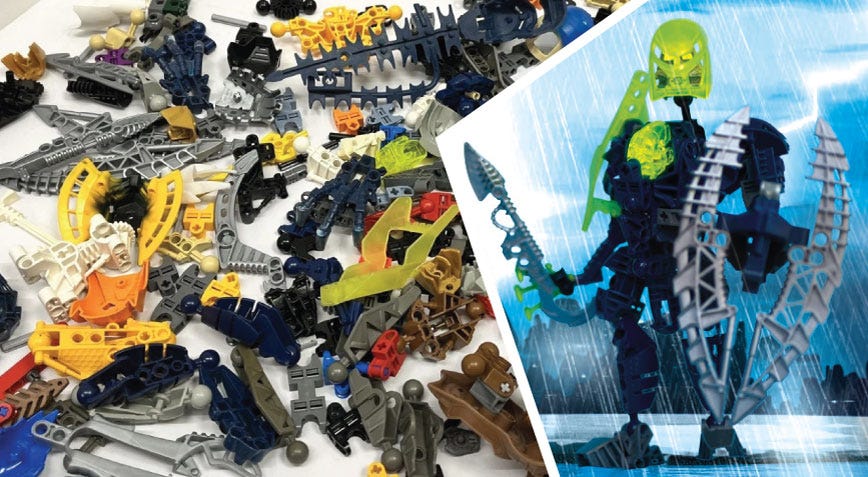
The Metru Ruins
In the time after time, there exists a vast, dilapidated city: the Metru Ruins. The clamour of industry has been replaced by the calls of strange beasts, and the roar of the immense waterfall that pours down from between the clouds.
At ground level, the city is submerged, the foundations of buildings rusting and buckling under their own weight. With the boulevards flooded, the Metroran traverse the network of cables overhead—all that’s left of the long-deactivated transport chutes that once funnelled goods and city-folk between districts. Foliage covers many of the buildings, and some of it is hungry.
Whatever societal structure orchestrated this environment is long gone. The masks and sustenance the Metroran need to survive are now vanishingly scarce, even as they adapt to the new, exotic foodstuff that grows by the waterlogged sidewalks. Some buried part of their distant memory tells them that things weren’t always like this.
Vrekkas
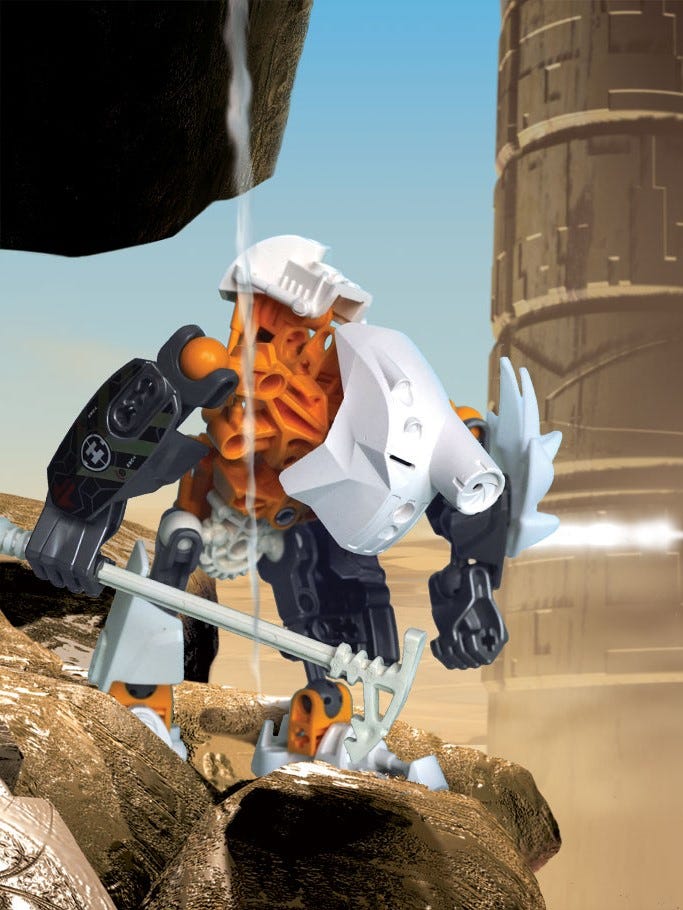
Vrekkas’ meticulous and paranoid disposition makes him unpleasant to be around—but if he weren’t that way, he would be long dead. As a prospector, Vrekkas delves into the most dangerous city blocks, combing the abandoned storeys for supplies. For the right price, he can be convinced to act as a guide for those venturing outside their home district.
After millennia of scavenging, there isn’t a street left in the city that Vrekkas hasn’t picked over at some point. Increasingly, though, Vrekkas’ keen memory is failing him. Where his mind tells him there’ll be a reliable cable crossing, he finds only a collapsed pylon, trailing wire into the water below. He cannot tell whether the wildlife’s migratory patterns are changing, or if he has simply misremembered their movements.


As a result of these lapses, his reputation as a trailblazer has suffered—even though he gets his charges to their destinations eventually. They ask him if he thinks it’s time for him to go back home, and retire. What Vrekkas cannot admit is that he no longer remembers where his home was.
Vrekkas carries an axe, which he uses to gain purchase on near-vertical climbs. His mask has an in-built scope, allow him to accurately gauge the distance over gaps, and to spot hairline faults in walls, which he can widen with his tool to create handholds. He has holdalls on his back and at his hip, and often ends up carrying as much as he has the physical strength to lift.
Kramuta
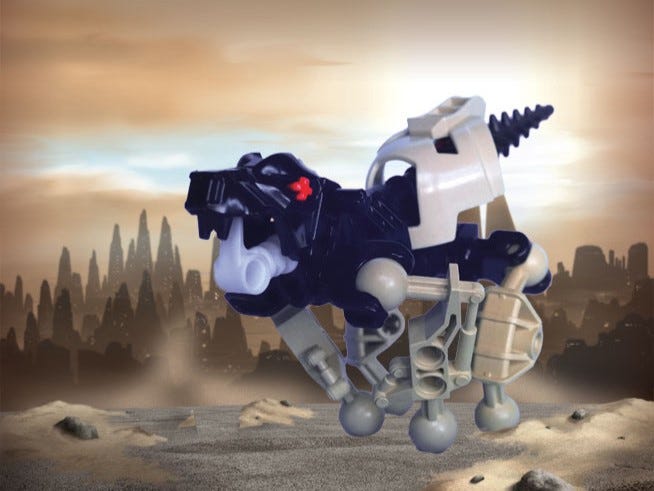
Once one of the more harmless species found in the city, the Kramuta used to feed on scraps thrown out of refineries and factories, and were sometimes even domesticated by the Metroran. They’ve since multiplied, and unfortunately for the city’s surviving denizens, they have self-selected for aggression and cunning.
On level ground, Kramuta can reach a top speed of 25 kio per hour. A Kramuta’s tail can drill through solid protodermis, but is rarely used for attack; rather, it serves to create a burrow to hide from larger predators. Their primary offense is their vicious bite, with jaws stronger than a hydraulic press. They sharpen their teeth by chewing on fenceposts and railings.


Vrekkas says: “A Kramuta can track you across the length of the city. If you’re mean enough, probably you can scare off one or two. But if a whole pack of them is on your tail, your best bet is to get out of their reach. They’ll be so busy snapping at one another, figuring out which one of them is gonna get the best bits of you, that they won’t notice you climbing across to the next block over. Just don’t wait too long to make your move. I’ve seen them bore a whole building right out from under someone. And if they have to work for their food, that only makes them hungrier.”
Ampiru
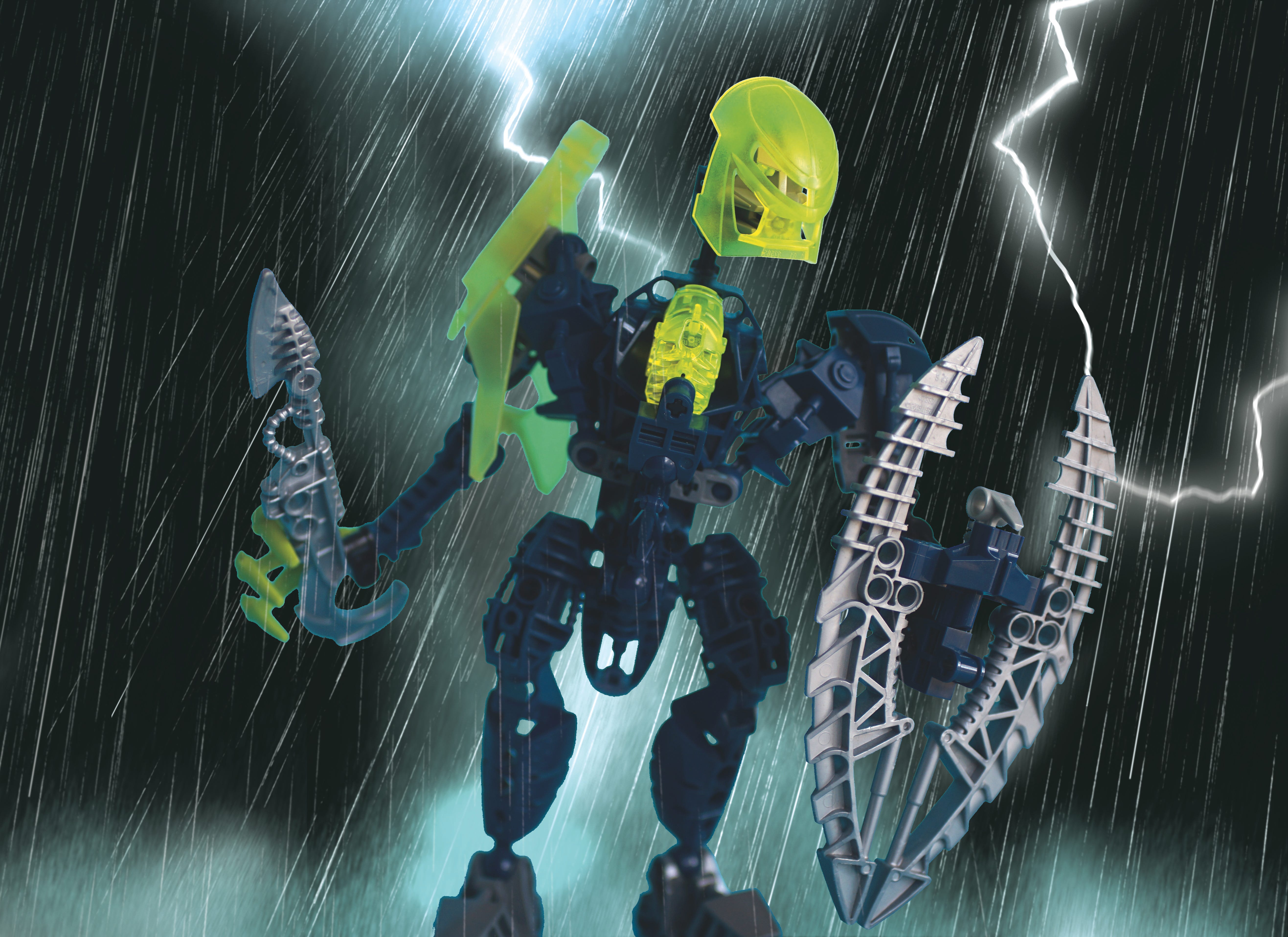
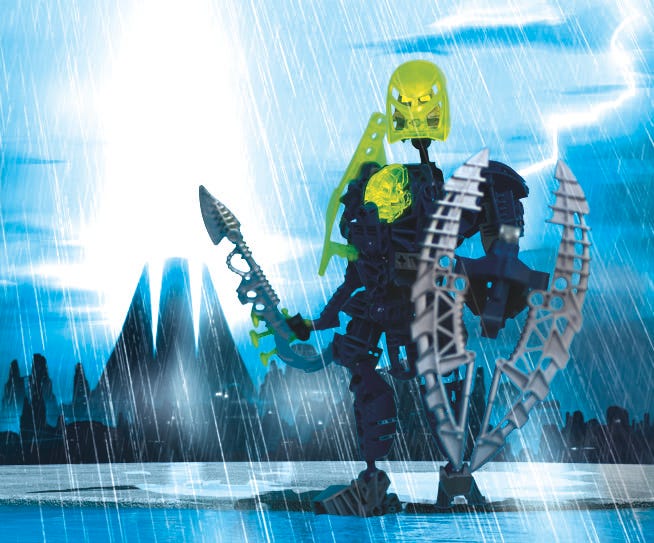
Gray clouds gather, blotting out the twin suns that hang above the city. Where they grow darkest, thunder rumbles, and great arcs of lightning scour the rooftops. Rarely, glimpsed between structures, a tall figure appears silhouetted. At the eye of the storm is Ampiru. This once-hero is now more akin to a force of nature, detached from the struggles of others, behaving according to her own strange drives.
In forgotten records of an ancient Order, Ampiru has discovered the truth about the city: that it is the dormant mind of a higher power. Desperate to restore her world, she is channeling massive pulses of electrical energy into the city’s structures, hoping that the right jolt in the right place can jump-start the great being’s neurons, generating new patterns of thought for the first time in millennia. The thunderstorms she generates have a tendency to scare away even the most dangerous of the city’s beasts, and the Metroran are quick to move in Ampiru’s wake, scavenging whatever they can before the animals return.
Ampiru does not realise the futility of her efforts. The great being’s cortex lies deep underground, and even if she were to discover it and reactivate it, it cannot function without the ministrations of the city’s population at its full quotient—no matter how many buildings she electrifies.
Mask of Levitation
This mask bestows upon its wearer the ability to leap great distances or hover in the air. Ampiru hates to touch the ground, and usually floats just above it. Her mask has proven indispensable as she traverses the vertically-stratified urban environments, from the depths of the Great Archives to the peaks of the Knowledge Towers.
Mael Aegis
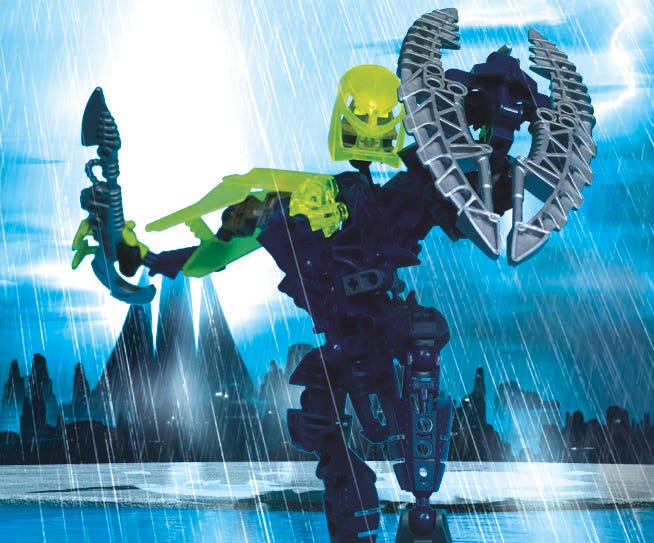
Ampiru’s shield absorbs any form of energy directed at it, building up charge with every blow. This energy bolsters Ampiru’s elemental powers, allowing her to create massive electrical currents and chain lightning. The Mael Aegis’ sharp edges also allow it to be used as a cutting weapon.
Cable Grapnel
This harpoon-like tool fires a pointed head, trailing wire. Floating above the rubble using her Mask of Levitation, Ampiru can use the Cable Grapnel to quickly pull herself between the edifices. In combat, Ampiru uses it to hook her adversaries and draw them into close quarters. It also allows her to set electrified tripwires, snaring careless foes.
Vrekkas says: “I’ve seen her, aye. When was it…? I was working at the storm’s edge. Got myself in a tricky spot with a doom viper. Was close enough I could see its breath, so I knew I had seconds at most. Suddenly the thunder got loud, much louder, and this monster gets struck by lightning right in front of me, falls dead. For a moment I couldn’t believe my luck—but of course, it wasn’t luck, was it? I could see her looking at me and I remember thinking, maybe this is it. Reckon she was thinking about killing me herself. But I guess I don’t know. There was a flash and she vanished, just like that. Don’t know when that was. I’ve always avoided the storms.”
Commentary
BIONICLE has been part of my life for basically as long as I’ve been conscious. I’ve never really participated in the organised BIONICLE fandom, but I still like it, and still think about it. Back in 2021, during the pandemic, driven mostly out of frustration with the neverending slew of wrongheaded pitches for a BIONICLE revival product people kept submitting to LEGO’s crowdsourcing site, I made a pitch for a remake of Toa Tahu (“the red one”) using regular LEGO pieces, which limped to just 40% of the votes it would have needed to enter consideration to become a real LEGO set. Just two years later, LEGO themselves designed and released an almost conceptually identical set, which was extremely vindicating to me, because I felt like it proved I’d been thinking along the right lines!
Anyway, to promote my pitch, I had the idea to write a BIONICLE web serial (what was I thinking?), of which I wrote 22,000 words, four-and-a-half chapters (just two were published). One of the things I wanted to explore at the time was the cultural appropriation which is absolutely central to… well, basically every aspect of the BIONICLE setting and aesthetic, mostly of Māori language and culture, something which was completely opaque to me as a child but which I’d become interested in as an adult. I strongly recommend reading Emily’s essay “polynesian cultures and bionicle”, which examines these elements of the BIONICLE story with an unflinchingly critical lens. If I ever go back to my BIONICLE fanfic (I’d like to!), I’d need to think more seriously about how to forefront that lens.
In the meantime, I’ve decided to simply to eschew any BIONICLE terms that are directly lifted from polynesian languages. From 2003, the BIONICLE creative team ditched the “tropical island” angle from the storyline and began strictly to use new made-up trademarks that merely sounded like the Māori words they’d been using up to that point. In fact, for the back half of the series, most of the names actually evoke words we use in English: Ehlek the electric eel, Kalmah the squid (calamari), Vamprah the vampire bat, and so on. However, for the existing characters and concepts they’d already banked on, the Māori terms persisted. For the material above, I decided to take things a step further, and write around those terms entirely.
This approach, and the accompanying setting (a bad-future post-apocalyptic Metru Nui), was conceived for a few BIONICLE models I was designing a couple of years ago. I finished three of what I intended to be a team of six; hopefully I’ll find the time to do the other three at some point.
Models
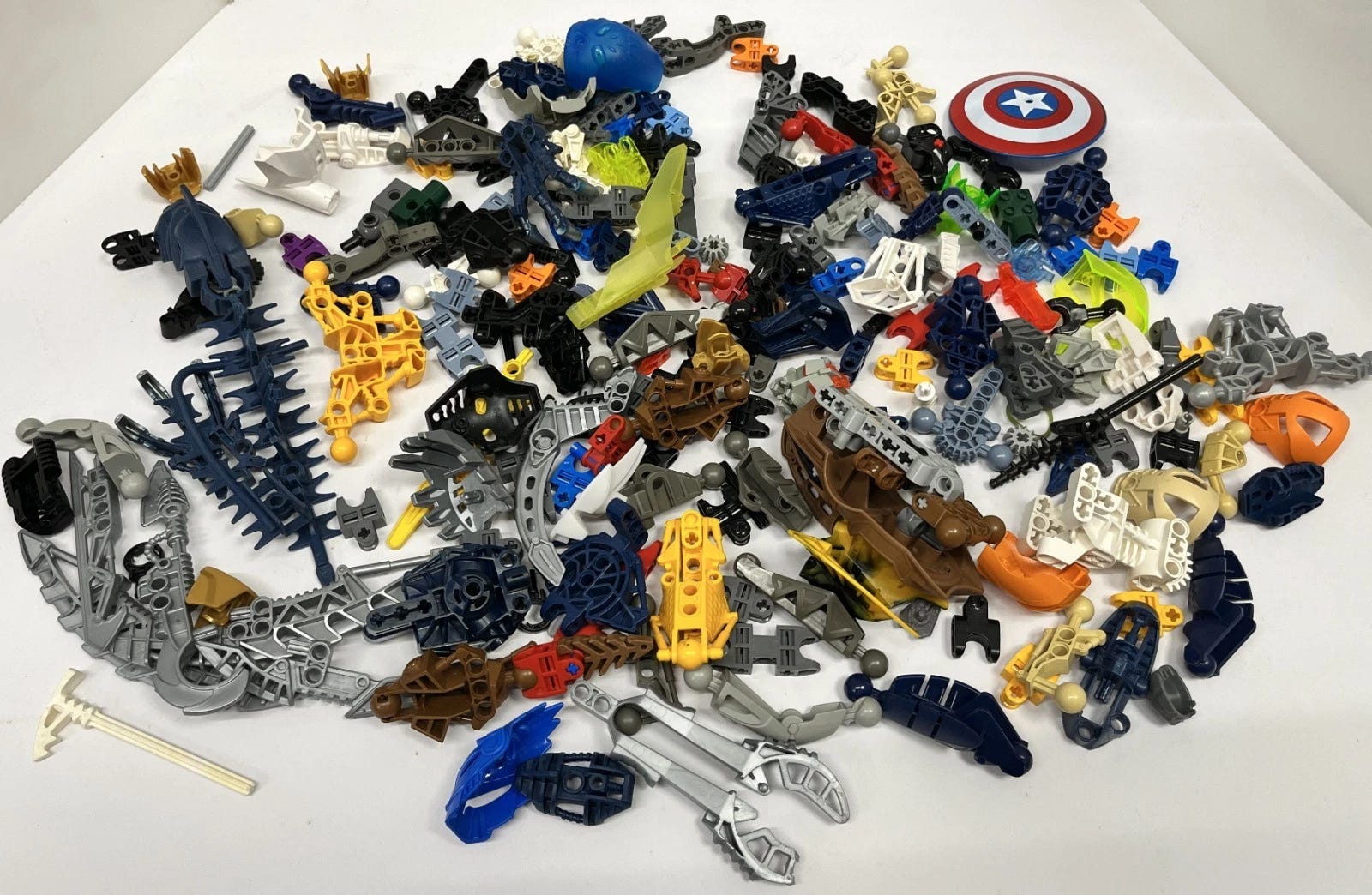
One of the models I’d designed was engineered around a particular mask piece, and the other week I happened to be on eBay and I spotted a job lot of pieces being sold by a charity shop, which had this mask and several others. At around £20, the lot was more expensive than buying the mask individually would have been, but I felt like I’d be able to sell on the other masks to recoup the cost, and have more fun with the pieces in the meantime.
Ampiru
The lot turned out to be in worse condition than I expected: many of the socket joints had cracked, some of the pieces looked bitten or faded. The only thing approximating a complete set was Roporak, the brown Visorak spider, who was basically useless from a spare-parts perspective; I decided to keep that model as it was, just in case I was able to get the missing pieces at a future date, because then I could just sell it on. Apart from that, I noticed a lot of pieces from Vezok, the blue Piraka, plus a good number of pieces from Toa Nokama and Vahki Bordakh (also both blue). This meant that working in earth blue would grant me by far the most flexibility in terms of parts. I also quickly identified a trans-fluorescent green Miru and a trans-yellow cowl piece from Rorzakh as eye-catching elements to build a model around. The only other pieces I had in a similar shade were a bright yellowish green Nui-Rama claw, and a head from Hero Factory Surge. Working out how to incorporate this head into the model’s torso proved one of the most challenging elements of the build.
The real problem was that—as is often the case with job lots of BIONICLE pieces, usually filtered out from broader collections of LEGO—most of the small TECHNIC connector pieces (pins, axles, etc) were missing. Every single one had to be used carefully, and I had to make the most of pins and axles which were already molded into the BIONICLE elements themselves.
I started with the legs, because simply by swapping Vezok’s claws for Vahki feet I could create a much more heroic look using only a handful of parts. Next, I worked out how I could make a surprisingly bulky physique simply by using Vahki shins to fill out the sides of the Toa Metru torso. To sandwich the socket for these in place, I used a Metru foot, repurposed as a kind of codpiece. The hips were then attached to that. I originally wanted the Vahki head to be hip armor, like a skirt, but the geometry didn’t work, so instead I moved it to the shoulder, giving me license for a bit of asymmetry in the arms.
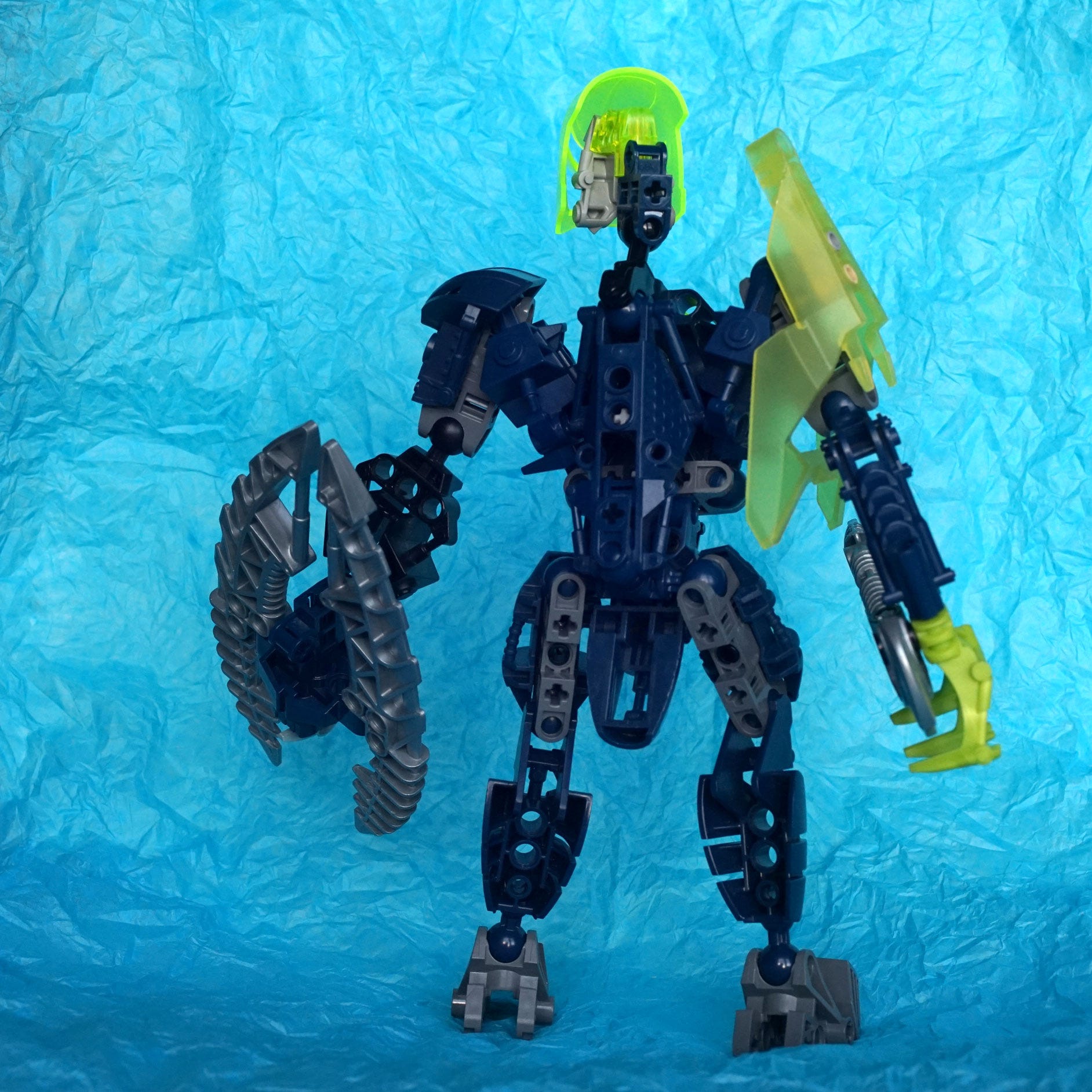
Again, lacking any small connector pieces to work with, I was forced to use much larger limb pieces running up the front and back of the torso to get the chest and head into place. Together with the Vahki shins on either side, this means that the torso is completely surrounded by limbs attached at the bottom, with nothing supporting them at the top. This limited the weight I could pile on top of those limb pieces without them flopping away from the body.
As it happened, I was curiously limited on weapon pieces anyway, and quickly identified Bordakh’s staffs as having the most potential. To visually distinguish them from how they were used in the official Bordakh build, I decided to combine them into a shield. My original build—consisting of a Vahki neck pinned to Metru hips holding a pair of sockets—was far too heavy. I realised the Vahki shoulders were the correct width to hold the staffs apart at a fraction of the weight, and though this made the shield a bit insubstantial in the end, I felt like it was much closer to what an official model would have done. For the offensive weapon, I used Vezok’s harpoon, mostly because it could be held nicely by the bright yellowish green claw.
Unfortunately, of the three Vahki feet I received, two had cracked sockets, and I was forced to use one of them, because I felt like aesthetically these feet were far better than any other option I had. Because of that loose ankle, sometimes I would come back into the room after a couple of hours and find that the model had fallen over. Oh no!
Kramuta
Originally, I was going to stop there, but the thing is that I really like playing with bionicles.
Amongst the pieces, rather incongruously, was a LEGO Vikings Fenris Wolf head. Though designed to accompany BIONICLE pieces in a creature build, it was designed specifically for the Vikings theme, and never saw use in BIONICLE sets, giving it an unusual quality. However, I had effectively run out of connector pieces entirely. To get around this, I used Turaga Whenua’s drill staff—which had a long axle for a handle—as the core of the body, using black Hero Factory socket connectors to expose the four sockets I needed for legs.
I was limited on limbs; brick yellow was the only colour I had two pairs of matching limbs in. Luckily, I also had a brick yellow Noble Huna to incorporate more of this colour. The Rahi creatures that served as the antagonists of the initial 2001 wave of BIONICLE all had corrupted masks controlling them, so this also matched how Rahi are presented in the lore. Using a single stud (one of maybe a couple of regular LEGO system pieces accidentally left in the lot), I had just enough clearance to attach the mask to the TECHNIC hole on the drill, threading the staff through the hole on the mask’s brow. In the end, I had a spare bright red 2L axle to use for eyes, mounting the head itself using a 4L axle, which pulled triple duty by giving the impression of ears and allowing for a biting function. A pair of leftover TECHNIC connectors served to bulk out what would otherwise just be exposed axle in the creature’s body.
Vrekkas
There’s a clean break between BIONICLE parts, used from 2001-2010, and the “Character and Creature Building System”, its compatible successor introduced for Hero Factory from 2011 onwards (itself eventually replaced with the confusingly-named “System Character and Creature Building System”, which ditched the TECHNIC angle for the more familiar studs seen in the regular LEGO system). While BIONICLE sculpted detail directly into the joints, often in the form of little pistons, CCBS genericised the look of the pieces to instead use a layered system: a simple “skeleton” of ball-and-socket bones covered in “shells”, which themselves are detailed using specific armor pieces. CCBS is frankly much easier to work with, mostly because of a consistency in limbs: they all have a socket at one and a ball at the other, with extremities always having sockets. However, it looks worse. So to start with, I basically set aside all the CCBS pieces and challenged myself not to use them. In the end, Ampiru ended up with a single CCBS limb for a neck, just out of necessity.
Having already built two models, I ended up with just a pair of connectors: a single pin and a single axle. I thought it’d be fun to try and build one last model. I had a lot of white and yellow pieces, and by using CCBS for the limbs, I could keep things extremely simple. I was limited on armor pieces, so I decided to use a foot piece as a sort of thigh holster. The hunched back was added to sandwich the body against the head on the other side of my last axle. This, along with his skeletal, cobbled-together look, informed his characterisation. Considering my resources, I’m satisfied with how he looks!
Lore
I wanted Vrekkas’ name to have a clipped, hard-edged quality to it. His white and gold colour scheme means that, in lore terms, he’s a Matoran of Plasma, but as Matoran cannot access their elemental powers for the most part, and are now fiercely individual, I figure the Metru Ruins have seen a breakdown of the elemental model of Matoran culture and identity.
Kramuta’s name is inspired by a wave of Metru Nui animals who, in the wake of the Māori lawsuit, were given repurposed trademarks riffing on the original Toa’s names, all now beginning with “Kra-”. It’s theorised these trademarks were cleared for use as the Shadow Toa. The suffix “-muta” comes from “mutt”.
Ampiru’s name comes from “Ampere”, the unit of current; Matoran of Lightning were called “Vo-Matoran”, after “Volt”. I was unsure what element to make her, as her colour scheme doesn’t really fit any of the established ones, but felt like vibes-wise Lightning seemed like a good fit.
My basic idea for the Metru Ruins is an excuse to handwave away any contradictions with canon: it’s an alternate timeline! Things are different! The waterfall lifts an idea from Karda Nui, where a waterfall was similarly falling through a crack in the sky. BIONICLE has often dealt with apocalyptic settings; in fact, the 2005 story was already set in a ruined Metru Nui, overrun by dangerous animals.
Recently, I have been thinking about degenerative disease, which brought me back to the original idea of BIONICLE (as Christian Faber has explained it). The story goes that Faber was dealing with a brain tumor, and taking his pills, imagined that there were tiny heroes inside going into the body to fight the cancer. I was thinking about Metru Nui as the brain of this giant robot, and thinking about the Matoran as a kind of superorganism—like, all of the individual neurons working together. I realise that’s not actually how it literally works in the lore, but that’s how I imagine the idea was conceptualised. So it’s like, if the Matoran are neurons, then we’re personifying the individual cells, and thinking about cells as being directly, physically connected to all these memories and experiences. So the struggle for survival in a ruined city becomes about constructing a new routine and a new identity, when things that were once easy feel impossible.
Thanks for looking at my bionicles! This post has been a little different from my usual, but I might do another one like it, when I next have models to share. And if you’ve ever built a bionicle with a heavily restricted parts palette, please show it to me in the comments!
If you liked this post, please check out this page to find out how you can help me write more things like it. The main thing you can do is sign up for emails, so next week’s post goes straight to your inbox!
By now I’ve built up a solid archive of short stories and essays on this site, so if you haven’t already, definitely check them out!
I FEEL THE SAME

The triplicate suns are setting over Paradise Rock, the last of their light glimmering over Lake Lackadaisical as the waves lap. I am sitting in a chair I have dragged out onto the roof of my house. …


bionicles is old enough to have dementia now. Feel old yet?
I’ve always loved working with limited pieces like this, the techniques you end up finding like that way of expanding the metru torso are always really neat.