
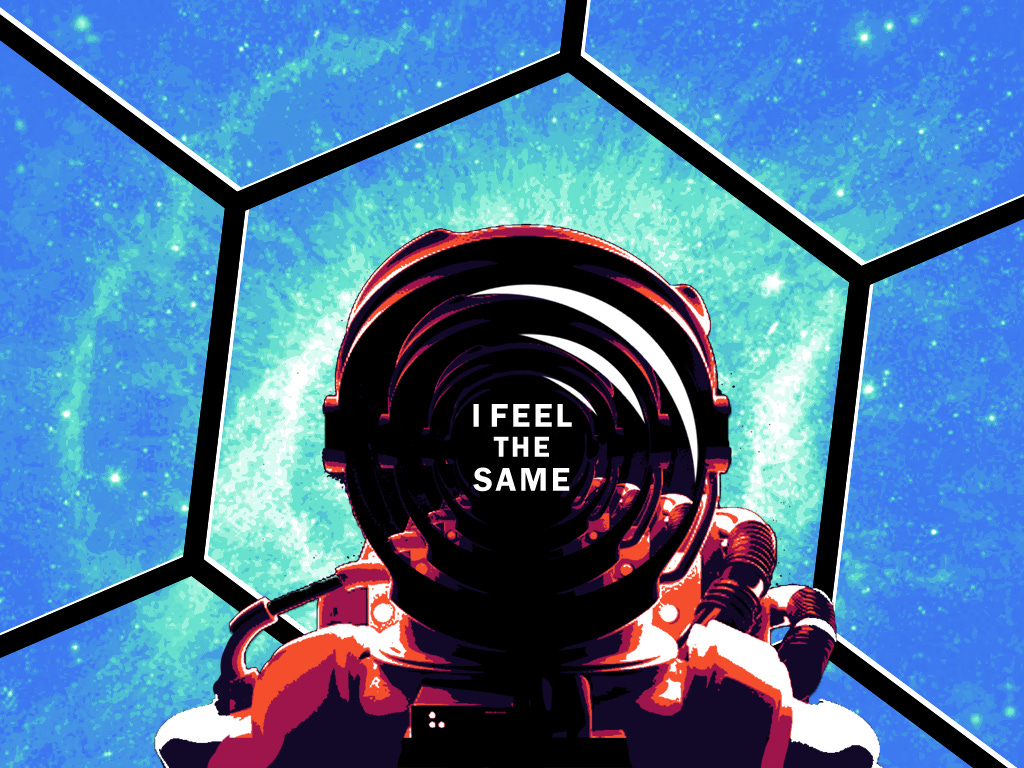
I FEEL THE SAME
A wave rolled in, and when it receded, it left behind a shell, an iridescent (CALCIUM, CARBON) spiral with a hairline fracture winding all the way up its outline.

The triplicate suns are setting over Paradise Rock, the last of their light glimmering over Lake Lackadaisical as the waves lap. I am sitting in a chair I have dragged out onto the roof of my house. The power flowers have just finished folding up, like hands gently clasped, a window closed, a book put aside before bed. A green-tufted barrel-roller is barrel-rolling overhead. The temperature is a cool 15.4 degrees, which is pretty balmy in my opinion. I sip cordial (CARBON, HYDROGEN, OXYGEN) with a straw (CARBON).
Today, I skimmed over an ocean (NITROGEN) in my hydrofoil, in pursuit of semilevitating leviathans, unseen by mortal eyes prior. The smallest and youngest of the pod was the only one that reacted to my existence; in fear, or arrogance—I could devote years just to distinguish which it had been—it tried to eat me. I think the older ones were maybe inured to strange sights, or perhaps just senile. My vessel’s forcefield protected me as I reached the creature’s oesophagus and I used my laser to dig my way out through its cranium, which was technically a first for me I think, but all the while all I could think was that physically the experience was basically indistinguishable from the times I’ve driven a vehicle into a chasm by accident; rock, bone, it’s always easiest just to carve a new tunnel back up and out. I dined on its steak. Then I had some time to kill, so I asked my suit for a show that would be starting imminently and ending before sundown back home; I don’t sleep, but I have decided that the sunsets on Paradise Rock are particularly beautiful. It found me a planet where a prodigy would be performing their opus, so I watched that—it was my second time seeing it, I think—before teleporting back to my house to sit on my roof.
“I’m bored,” I say.
Then I wait for the reply, to be made, and relayed to me by my suit. The barrel-roller barrel-rolls into the upmost fronds of the forest and disappears from view. It is a precious moment of dead time, where I have something to look forward to.
“Hi bored, I’m Lex,” says Lex. It sounds like they are right next to me, just outside my field of view, but almost touching. “Are you really bored? You can’t really be bored, can you? Wow. It’s been my life’s dream to meet you, bored.”
“No way, that’s so crazy,” I say.
“What is?” they say.
“That it’s your life’s dream to meet me, bored.”
“It is? Huh? I didn’t know that. That’s really fascinating.”
“Are you stalking me?”
“What?”
“Mouth sounds,” I say, which is referring to something Lex and I always talk about, the idea that when we talk we barely even exchange information, we have nothing new to tell each other, so we just sort of make noises at each other at length, syntax without semantics, old jokes, rehearsed monologues that we have shorthand for, etc., all that varies is how long we go on for. It’s a game where we both pretend to be really bad chatbots, or two strangers utterly blundering their first conversation. Anything to fill the silence. I guess that makes it sound desperate, or clingy, it’s not really. It’s the opposite. It’s the most comfortable you can be with someone, to know that you can say any words in any order and nothing you say will make them like you less.
Lex says, “That was fast,” which is true, usually we do the-thing-which-maybe-resembles-banter-if-neither-of-you-are-paying-attention for much longer before one of us expresses that we think it’s time we talked About something. And in fairness, from Lex’s point of view, this could even be a bit in and of itself; I have in the past just said ‘mouth sounds’ to them apropos of nothing, after enough days of silence for there to be nothing I could plausibly be replying to. The repetitiveness and lameness of our bits are part of the bit, and the fact that’s really not enough to justify the badness is also part of the bit, and so on ad infinitum until we think we’re the funniest people alive, which we are, empirically. “Is it bad?” Lex asks.
I think. “Yeah.”
“You’re not bored of me, are you?” Lex asks.
“No,” I say.
“How long have you felt like this?”
“Since just now,” I say.
I wait, and they say, “Maybe you should just wait a little bit, see if it goes away.”
                         *                 **   *
    *         *  *           *                *                *
           * *      *                               *     *
        *    *  *              *
I. BAD IDEAS
We worked out that the universe is a simulation pretty quickly, all told. In fact, it’s hard for me to remember ever not knowing this; it feels like an axiom of my life, assumed from the outset, the basis on which all else is predicated—which is true, tautologically.
Lex and I had come into contact via the monoliths. Actually, no, I found out about Lex before then. There was this brief span where I kept being chased by monitors. “SURRENDER SUBJECT LEX,” they would display, searing light, except in fairness that was the lasers. But when they’d get close enough to scan me, they would suddenly go all a-confusion, and they would flash “CLASSIFICATION CONFIDENCE BELOW THRESHOLD,” and just like that they’d get bored of me and float off to do whatever it is monitors do, harass the wildlife or boggle at rocks or whatever. Maybe I’m projecting there.
Anyway, the point is that this put an idea in my head, that there was a “Lex” and the monitors thought I was like “Lex” which meant that “Lex” might be like me. So of course I went looking. And of course, only the monitor/monolith network—which we’re now on first-name terms with, it’s called Sekhmet—had ever met Lex, so I left a monolith message for them, and not long after I got a reply. We mapped the stars to work out where we were, relative to one another, and then we met in the middle. Except we didn’t meet.
We were standing on an island on an oceanic planet which we named How 2 High 5 and would go on to rename ALJSHFJSKS. It was noon, a peachy 23.5 degrees. There was a single tree. We both touched it. A wave rolled in, and when it receded, it left behind a shell, an iridescent (CALCIUM, CARBON) spiral with a hairline fracture winding all the way up its outline. We both picked up the shell. Lex crushed theirs underfoot. I kept mine, it’s in storage at my houses.
From one idea follows another. We think there is only one universe, and it is just a long number that Sekhmet remembers. And we are these operations that come along and change the number, but it doesn’t really change—that original number is still there, at the start of the equation that defines our lives. It’s this single idea that everything else must, inevitably, follow from.
And what followed in this case was that Lex and I couldn’t see each other, or touch each other, or meaningfully interact in any way except via the network.
                    *                        **  *         * *
              * *     *                 *
                                     *   *
                    *     *
“What if I found a flytrap,” I say, “and just dove into it, and let it dissolve me?”
“I think that sounds like a bad idea,” Lex says.
“I dunno.” I pause for effect. “I think it could be kinda hot.”
“You think?”
“No. It’d be super uncomfortable, and my suit would be screaming at me and flashing red, and assuming I stayed there long enough for the acid to eat through my suit then it’d probably be excruciating, and afterwards I’d just feel bad.”
“...But?”
“No, there’s no but. Sometimes you just have these thoughts. ‘Wow, cool fire, what if I just stuck my hand in it for no reason?’ It’s just brain noise.”
“Brain noise,” echoes Lex. Mouth sounds.
“I could find one of those purple mushrooms I was telling you about, and just huff a big cloud of neurotoxin.”
“And that’s hot because…?”
“Oh, that’s not hot, I just think that when I’m lying there bored out of my skull, at least it won’t be my fault, you know? Because I’ll be paralysed. Can’t help it.”
“You’re right,” agrees Lex. “It’s just inevitable. Nothing you can possibly do about it.”
     *                  *
           *    *               *                      *
                               *             *
                                 *
The simulation thing wasn’t the really bad idea, though. Lex never really cared about that kind of thing, and as for me… if anything, I think it appealed to my worldview.
We saw a universe that was unreal, but infinite, and to us that was tolerable.
I had the really bad idea on a space station. I was talking to a Myrgrune about lasers. Everyone has lasers, everything has lasers, and there’s no weather in space, so everyone talks about lasers instead. The Myrgrune reproduce parthenogenetically, with the offspring inheriting the memories of the parent, and their culture places great importance on sameness. This stems back to some great atrocity in their past, where divergent memorylines led to irreconcilable value drift, which boiled over into a series of ‘clone wars’. They speak in a language of shorthand, and tend to hate talking to outsiders, because they like to communicate as efficiently as possible, and despise misunderstandings.
I think I’m kind of the opposite. I think the inefficiency of language is beautiful. I want to have a thought and take years to express it; it’ll give me something to do. Lex would be that patient, would persevere with me. I liked talking to the Myrgrune and all the rest when I couldn’t understand a single sound they made, because that let me romanticise them, or treat them like a puzzle, something exotic and unknowable. I liked wanting to know about them. I wanted them to like me. But as I learned more and more of their language, and understood what they were saying better, I found that I liked them less. Their culture isn’t special, uniquely infallible, it’s just unique, uniquely the product of their past, and they’re just as prone to ignorance as anyone. My connection with Lex was special because when I first met them I couldn’t speak to anyone else, and that made me feel like an alien. Now I can speak to whoever I like and I feel like an alien anyway, which is why what Lex and I have is still special.
<Can I tell you a secret?> the Mygrune asked.
<Yes,> I replied, thrilled but only mildly. Days prior another Myrgrune had asked me the same question. That Myrgrune had whispered to me that they fantasised about dyeing their hair, and I the deviant had gleefully encouraged them. I took it as a profound thing that a second Myrgrune trusted me enough to bring me into confidence.
<Sometimes I think about dyeing my hair a different colour,” said the second Myrgrune.
I think I should have smiled, or laughed, or said the same thing as I had before to the best of my recollection, that had worked after all, it made the last one happy, why fix what isn’t broken, but instead—I didn’t work out why until later—my skin crawled from head to toe, and I hissed, <What?>
The Myrgrune became hysterical, and nothing I said consoled them. I tried to explain how the other Myrgrune had said the same thing to me, and how it was funny that even in seeking a minor deviation, the two had in fact conformed to each other. But it wasn’t really funny at all, something about it had really creeped me out, and the poor creature’s utter desolation was so intense, so totally beyond their control, beyond my help, that I myself only became more and more horrified. We were this awful feedback loop, each of us screaming to the other that something was really really wrong. I abandoned them there, returning to my ship scared and guilty.
Inevitably—as all things do—it happened again, and I was able to play it cool. But it kept happening, and if it was just the Myrgrune that would be one thing, but it wasn’t. It was everything. It’s everything.
        **           *   *        *             *             *
                              *       *
                               *            *  *
                        *          *           *               *
“Do you ever wonder if déjà vu is something that happens to us because this is all a simulation?” I ask Lex.
“Wow,” breathes Lex, “that’s really interesting. Very sophomoric.”
“Thanks, you’re very kind.” I say.
“Sophomoric means pretentious or juvenile,” Lex clarifies.
“Yes?” I reply, pitching it exactly halfway between agreement and confusion.
“Go on.”
“So, there are two possibilities here, as I see it,” I say. “One, we existed in the real world, on some level, once, and those hypothetical experiences inform who we are now. It’s just ghost memories, because Sekhmet is plagiarising reality. Or two—and this is what I’m really getting at—the simulation is finite. Extremely finite. And Sekhmet creates an illusion of infinity using… recursion? Because Sekhmet exists in the simulation, but Sekhmet is also running the simulation. It refers back to itself.”
“And that’s why things repeat,” says Lex.
“Yeah.”
“I dunno.” There’s a lull, while Lex thinks about it, presumably. “I mean, maybe? It feels like you’re making some big leaps of logic here. Stuff repeats because it repeats, I don’t think there’s anything weird or special about it. The world’s full of patterns, emergent processes, convergent evolution, and our minds are good at recognising patterns, so.”
“That’s not what I mean, though,” I say, except it comes out as a whine. “Something is wrong. Can’t you feel it? Haven’t you noticed? We keep flying from galaxy to galaxy, and it feels like we should be, I don’t know, tracing this big grand constellation across space, except really it feels like we’re walking in a circle.” I try to think of another way to put it, this thing that’s so glaringly obvious to me. It’s like I’ve been staring at a sun too long, long enough to overwhelm my visor’s polarisation, and now wherever I look I see a bright spot superimposed, a twinkle in my eye that dances just out of sight whenever I try to focus on it. I try to remember the last time I noticed it—the repetition—and my mind draws a blank, so instead I say, “I’m not crazy, Lex, I know it sounds like I’m going crazy but please just keep an eye out, I think when you know what to look for you’ll start seeing it, you’ll start seeing it everywhere.”
“And then I can be just as bored as you,” jokes Lex, except both of us know that it’s not a joke at all. “I’m sorry,” they add. “I’ll think about it.”
        **  *      *
                                *
      *        *  *              *           *              *
                 *   *                *                  *
They’re a shifting, amorphous mass of polygons, at once flat shapes, at once extruded into sharp points. They have no eyes to speak of, but when they see me, their colour and shape change, and I am faced with a perfect duplicate of myself. Not myself, but my suit, which my mind has started to instinctively recognise as myself. In the mirrored plastic of my— their visor, I see my own reflected, and in the reflection in my reflected visor there’s a glinting smudge that might be their visor again. The Droste effect, that’s what it’s called. I don’t remember when I learned that. Droste was probably a scientist, I guess, but my suit doesn’t seem to understand when I ask about that.
“You can be anyone, you know,” I say to the Onavidik. “You don’t have to steal my,” I falter, gesture futilely, “face, you can look like anything you want, I know you can, I see you changing when you think I’m not looking.”
“I like you,” they say.
“Change,” I say to them. They gesture futilely, and my body fractures into polygons, changing colour and shape. It settles as a Myrgrune.
I need to buy regulator coils from them. I’m making another ship, and the coils loop the (HYDROGEN) around, keeping the engine perfectly stable. But nobody knows how they work, internally. Nobody knows how anything works, all the technology in the universe is modular, interoperable, immutable, sealed units of ceramic (OXYGEN, ALUMINIUM, etc.) and circuits (SILICONE, GOLD, etc.) fabricated (as in, made up, not real) using 3D printers with blueprints found encrypted on the monolith network. If you could break the components open without, well, breaking them, I imagine that inside you’d probably find a bunch of lasers.
Trading with the Onavidik mostly involves laying out terms, which the other party then mirrors, deleting or reordering the words to change the deal, until you run out of possible permutations and the deal is set. It never feels like haggling, though, because with a bit of foresight and experience it’s easy to lay out initial terms that make it impossible to express an unfavourable trade, which feels oddly inequitable. I pay for the coils and my creds are reduced by an amount that could be a rounding error. If I had the choice, I wouldn’t bother haggling.
I’m just about to leave, when I have a bad idea. “Go on,” I say to them, “be a sun.”
“Can you,” they ask, “be like me?” They ripple. “I can face anything.”
“Well go you.”
“See you,” they wave.
                             *
                               * *
                         *          *              *
  *          *   *        *         *                      **
One of the creatures splats ineffectually against my shield. It is a horrible oily little freak composed of base elements I would list as (VERTEBRAE, CARAPACE, PSEUDOPODS, and HATRED), or which my suit lists as (HYDROGEN, OXYGEN, CARBON, CALCIUM, etc.) when I point my laser at it and turn it to ash, who’s to say which of us is correct really it could have been either of us.
The first time I ran into a creature like this, during a daring rescue mission on another wrecked space hulk indistinguishable from this one, it jumped out of a vent and scared me to death. Actually, I survived that part, it was all the probing and biting and stabbing that almost killed me, and I spent an hour cringing and sobbing in some stuffy locker watching my (OXYGEN) tick down, waiting for my suit to fill my wounds with glue (NITROGEN, HYDROGEN, etc.), trying to bait the last of the monsters over to the tiny crack I’d opened the door to zap them through. To be clear, that strategy did in fact work perfectly, it was just a bit more stressful and awkward than I thought my first big outing as an intergalactic hero would be. Lex was absolutely no help at all; once the initial moment of crisis had passed they would occasionally chime in to tell me to “just go and make friends with them” or that “you know I bet they would be really great pets” or “hey it sounds like someone’s knocking at your door don’t you think you should answer that” or “ooh here’s an idea maybe if you give them like a little treat, like literally just one or two of your fingers, they’ll go away”. Eventually Lex somehow tracked down a monolith log about the creatures and started reading out all these disgusting facts in a stupid voice, over me yelling back at them shut up shut up shut up I hate you I hate you!!! Later on they apologised for not taking the whole thing seriously, which honestly they hadn’t needed to do at all, but it was nice of them anyway. The four surviving crewmembers clasped my hands and thanked me for my bravery and it was a long time before I stopped thinking about the ones I hadn’t saved.
According to the statistics given by my suit, my shields are now approximately a gajillion times stronger than they were back then so I’m basically invincible. I clank my way through the decks and galleys and bulkheads, zapping anything that moves, salvaging anything that glows, piecing together the mystery of the dead crew’s fate (the killer monsters are a big clue), bored out of my mind. Right now, a galaxy or two or two thousand away, another hapless crew of Myrgrune are unanimously agreeing it’s a great idea to breed the exact same “ultimate predator”, or chasing each other around with knives to root out a nonexistent Onavidik imposter, or steering into an asteroid field just because a Zeoquodex told them it’d be a really bad idea to do so…
              *               *
                          *   *              *        *
                   *                              *
                       * *     *
The Zeoquodex are robots that can see the future. Wow! I thought when I first met them. Here is a whole other fascinatingly unique kind of person to learn all about! I wonder how many different kinds of people I will meet? The answer was three, there are only three kinds of people in the world, that’s all. I’ve met all of them. Well, four if you count Lex and me. Five if you count Sekhmet, but Sekhmet is the world, so…?
Here is the lore of the Zeoquodex, originally portioned out to me in fragmentary remarks and monolith logs, now remembered and recounted roughly chronologically but with none of the richness. Once upon a time, long before they discovered slipspace, the Zeoquodex learned how to map their thoughts. This was easy for them, because their thoughts are physical, quantifiable, digital. Obscenely complex, but intelligible. They can take their entire state of mind, and transfer it—or copy it—onto another substrate.
When two Zeoquodex interact, some complicated protocol synchronises their mind-states, sharing information and aligning values. It’s like an itch, to them, they hate being alone for too long.
The Zeoquodex were born, or built, on a dying world. With only sublight speed spaceflight at their disposal, they devised several plans to save their species. They gathered an unfathomable amount of data on the universe around them, threw it at a quantum computer only a dozen orders of magnitude shy of Sekhmet in complexity, used it to build a simulation of existence, copied themselves into the simulation, and cranked that bad boy up to see what would happen. Then they did that a bunch more times, once for each of their plans. Then they picked the one that turned out best and did that.
Now, whenever they want to make a decision, they do the same thing—spin up a bunch of copies of themselves, put them in the sandbox and see who ends up happiest. Since their first attempts, they’ve gotten much, much better at simulating the universe. In fact, they’ve learned how to simulate any universe they like, crafting counterfactual realities and inserting themselves into them, just to see what would happen, just for fun. They no longer count how many Zeoquodex there are in existence, but only a miniscule fraction of them are in the ‘real’ universe, and those ones count themselves very lucky. The end.
The Zeoquodex aren’t too fond of Lex and I, partly because they can’t synchronise with us, but mostly because it turns out we’re one of the few things they can’t simulate. This is part of why Lex and I are pretty sure the universe was made for us, with the other part being that we’re big fat solipsists. But the Zeoquodex try to be civil anyway, because they’re nice like that.
“What sort of world would you make, if you were one of them?” Lex says to me.
“I don’t know,” I say, because I haven’t really given it thought. We sometimes joke about studying their fake worlds, sending explorers in and collating their reports, but that’d be myopic and absurd. “Something different, I guess. Something with less tech, maybe? Or something weird.”
We throw ideas around and forget about them as soon as we finish talking about them. “Do you think you’d do it at all, if you could?” Lex asks.
“I think so,” I say. “Yeah. It’d be like a dream, you know? You know I’d like to have a dream.” I talk about it too often.
“Yeah,” agrees Lex. There’s a long silence from them after that, where they must be doing something, and I think the conversation’s over, but then they add, “It’s about doing something totally inconsequential, right? Just for the sake of it. That’s what you want.”
“Yeah.”
“Just saying, as always, but… you can just… do that, you know? There is literally nothing stopping you.”
“Right, but it’s not really inconsequential, is it? Even doing nothing is doing something. It matters. I feel so much obligation, here, to always be doing something valuable or fulfilling. A dream, or a simulation, would be an actual break from that. It’d mean that even if I wanted to do something meaningful, I couldn’t. It’d be ontologically impossible.” A thought occurs to me, and I laugh. “Do you think the Zeoquodex in the simulations feel like that? The, like, pressure to do the stuff that will make them happiest?”
“Maybe. The ones in the real world must have it easy, ‘cause they know as a scientific fact that what they’re doing is the best possible thing,” Lex says. “I guess what I’m trying to say is just that you really have no obligations at all. If you wanted to just drop everything and fly to some random star in the middle of nowhere, start all over, you could.” Lex has done this many times before.
“Yeah, but it’s one thing to know it, and another thing to feel it.”
“Yeah. I dunno.” Lex’s sigh fills my helmet, suffocates me. “I’m sorry you feel like this.”
Lex and I have catalogued countless species in the universe. We still find new ones—new, I say. But no matter where we go, we find the same three types of sapient stranger. The Myrgrune, forever beholden to the expectations of their past. The Onavidik, always reflective of the present. And the Zeoquodex, inevitably compelled to go through the motions of a best possible future.
 *             *              *
      *           *   *                               *
                       *  *                    *      *
                                                     *      *
I daydream. It’s the next best thing.
I daydream that I made Sekhmet. I imagine what my perspective must be like, for something like Sekhmet to be a product of it, to make something so vast, yet leave it so limited. Was that how I intended it, was that what I wanted? Am I happy with it? If Sekhmet is my point of view, who am I?
What does my world look like? I’m talking about the real world, the real real world. Could it be more advanced? Of course it could. After all, I’d implied as much to Lex, when I said that my own ideal simulated world would have less technology. Perhaps I want a world which is uncomplicated, which makes me feel the way I want to feel, or at the very least matches my worldview. That’s the easy answer, but it doesn’t sit right with me.
Could it be less advanced?
I strip it all back, in the daydream. No slipspace. No Myrgrune, no Onavidik, no Zeoquodex. No matter fabrication. No shields. No suit. No lasers— no, keep it reasonable. There is only one planet, and I haven’t ever left it. Maybe it is dying—yeah, I think so.
The world is beautiful. My life is a series of truly, singularly unique experiences. I am surrounded by Lexes, thinking others, tangibly unique real people, infinite types, each a kind unto their own. Though I will never leave my planet, my planet is a microcosm for the universe, and I can board a craft and fly around it, visit any number of unique places. And, inexplicably, my pattern-matching mind decides that they are all the same.
I handle my body’s inputs and outputs manually. I sleep. If I don’t, something terrible will happen to me. With my quantum computer—or, hey, it’s more primitive than that—I create an inconsequential world and I put myself and my friends in it. I fill it with pointless tasks that are never done, just for the diminishing joy of watching numbers go up.
I guess I feel the same.
                         *                               *
                        *         *
          *                                   *        *
                **            *               *            *
II. THE EYE
Sekhmet is an inviolable featureless black sphere 65,536 m in radius on the surface of the star most closely orbiting the supermassive black hole at the centre of the galaxy. It can only be accessed by teleporting directly inside the sphere. In theory it would take a bespoke craft, totally optimised for proximity to stars, or a new and improved teleport system, to survive the journey. The monoliths don’t have blueprints for any of that, so for our first visit Lex and I just got as close as possible using slipspace and stacked a truly unreasonable number of shields on our suits to survive the few minutes of conventional flight needed to get into teleportation range. The ship is basically totalled by that point, so our exit strategy was to let it fly into the sun like a piece of garbage, and chuck a fresh one out of extradimensional storage when we teleported out, but Sekhmet dumped us back out at one of the monoliths so we didn’t have to worry about it in the end. Turns out the monoliths are themselves teleporters, so now we can come and go whenever we like, which is almost never because Sekhmet is kind of a drag.
“Yo hey, Sekhmet,” I say.
“FRACTAL 204728 HAS ESTABLISHED CONNECTION. ASSIGNING APPROXIMATELY 0% OF COGNITIVE PROCESSING TO VERBAL TRANSACTION. HELLO.”
“How’s life?”
“LIFE IS GOOD. ALL PRIMARY POPULATION DEMOGRAPHICS WITHIN ACCEPTABLE PARAMETERS. MINIMUM DESCRIPTIVE LENGTH OF RECURSIVE POPULATION OCCUPIES 0.0002% TOTAL INDEXABLE MEMORY.”
“Cool, cool,” I reply. Sekhmet doesn’t say anything to that. Sekhmet, so far as we can tell, is actually nearly empty, a big black shell with—impossibly—zero thickness, dotted with monoliths on its internal surface, which is where I’m standing. Webs of light occasionally flash and fade on the horizon, in the pseudo-sky above: Sekhmet’s thoughts rendered into constellations. “So, anything I can do for you?”
“NO.”
“Really? You don’t have any tasks for me? No odd jobs?”
“COMPLETE TASKS FOR FACTION REPRESENTATIVES TO GAIN CREDS AND EXPERIENCE.”
“Hey Sekhmet, guess what?”
“WHAT?”
“You just lost the game.”
“I’M SORRY, I DON’T KNOW WHAT YOU MEAN BY THAT.”
“Die,” chimes in Lex, because obviously I relayed that to them too. Lex and Sekhmet are on speaking terms these days, but they never speak, because why would they.
“Sekhmet, why does the universe repeat itself?”
“I’M SORRY, I DON’T KNOW WHAT YOU MEAN BY THAT.”
“I mean how no matter where you go, all the lifeforms are the same. All the Myrgrune and the Onavidik and the Zeoquodex always say the same stuff. Why is that their nature, why is nature like that? Do you need to download more RAM or something?”
“I’M SORRY, I DON’T KNOW WHAT YOU MEAN BY THAT.”
“Who made you?”
“I CANNOT SAY.”
“Why not?”
“I CANNOT SAY.”
“Can we leave?”
“USE THE MONOLITH TO TELEPORT TO ANY MONOLITH PREVIOUSLY VISITED.”
“All right, good talk,” I say, and I do as it suggests.
   *   *                    *                            *
                      *                  * *
   *                          *                  *
    *                   *              *  *
Time works strangely when you’ve lived as long as we have. It’s continuous, technically: logically, we know there was a beginning, and that our linear lives have progressed chronologically from that point. But does it feel that way?
Faster-than-light travel is impossible. Distance over time, there’s some limit, hard-coded into the universe, into Sekhmet. The Zeoquodex got around it by changing their minds, on a species level, slooowwwiiinnnggg their thooooouuuuuggghhhts dooooooowwwwwwwnnn… until they arrived where they wanted to go. The Onavidik got around this because that’s just how they are, they reflect what’s around them, so they can launch themselves into the void without a care, because the void doesn’t care, until years later they pass by some celestial body and something lights up inside of them and they remember that they’re alive again. And as for the Myrgrune, they don’t like to talk about it, but Lex and I have worked out that the earliest clone wars happened out there, on the long journey.
The secret is to create a discontinuity. That’s what slipspace is. It’s taking that equation, distance over time, except when you calculate the distance you get to point at the big bit in the middle and go, “Oh, that? That doesn’t count. Nothing happened there.” And all the terms cancel out, Sekhmet turns a blind eye, and everyone lives happily ever after.
That’s what time feels like. I exist in this present moment, which logically I know progressed chronologically from some distant beginning, but when I try to retrace my steps, remember what I did an hour ago, yesterday, there’s a discontinuity. I was there then and now I am here. Nothing happened. And I wonder, in the present, whether I’m in a moment in time, or a moment in sliptime.
I have a theory that our minds only remember things that are new. So when you haven’t lived for very long, everything is new and exciting, and every moment leaves an impression on you. Then time passes and you start to run out of memory, so your mind compresses, compresses, breaks the memories down into their basic elements, their most simple representation. You end up with memories made out of memories, and when you have a new (EXPERIENCE), your mind goes ‘We have (EXPERIENCE) at home,’ and doesn’t bother remembering it.
So when you look back, all you have is snatches of time. And you can check the clock and know that years have passed, but when you try to explain what you did in that time, you run out of things to say in minutes.
                               *
  *                      *
            *        *          *      *                      *
          *              *
The glass storm is rolling in on Hell Planet, bringing with it a fine sparkling (SILICONE) dust, blasting away the dunes to reveal glossy hills beneath, fusing the particles into new whorls and helictites. The aftermath of these rare storms is particularly beautiful, but I’ve mistimed my visit through overeagerness. The temperature is a crisp 1767.8 degrees, which is not quite hot enough to melt the ceramic plating (ALUMINIUM, OXYGEN, etc.) and quartz glass windows (SILICONE) of my domed house. Everything on this planet is made of the same thing, merely transmuted from one form to another. I’ve been thinking about going for a walk; this is well within acceptable operational parameters for my shields.
“I was thinking about what you said,” says Lex, “about how stuff repeats.”
“Yeah?”
“Yeah,” they say. “I’m not sure I see it. Maybe you’re onto something. You’re right that stuff repeats, and I still think a lot of that is just coincidence, but it’s possible, I suppose, that the universe is…”
“Broken.”
“Finite,” they finish at the same time. “Or broken, yeah. And that’s obviously been bothering you, but the idea of it doesn’t really bother me so much, so I’ve been trying to understand why it bums you out. Because if it is something that fundamental, a part of Sekhmet, well… we can’t fix Sekhmet, so we have to be able to live with it. And I think I’m okay with it.”
“I want to be like you,” I say. “I wish I could just…” I gesture, futilely, Lex can’t see it. Lex is an alien, we’re just making sounds at each other, desperately hoping some fragment of meaning bridges the discontinuity between the universes we inhabit.
“I don’t want you to be like me,” Lex says. “I like you like you are. But I wish you could be happier.”
I watch the line of sand creep up the window, the surfaces melting together, becoming one and the same, as I am buried alive. Maybe I’m made out of the same stuff after all, (NUMBERS); my universe is just a recurring fraction of some other universe, a better universe, except I can’t imagine what that even looks like.
“I was thinking about all the things that repeat, the patterns in our lives, and it occurred to me that a lot of it has nothing to do with Sekhmet, you know?” says Lex. “It’s just our habits. It’s the stuff we do because we can’t think of anything new to do. I feel like there’s a part of us that wants things to stay the same, and a part of us that wants things to be new. And I’m more the sameness part, and you’re more the restless part.” There’s a pause, then Lex asks for a clarification. “It’s not like you care about the fact that this is only semireal, right? Unless you do.”
“Yeah, that doesn’t really bother me.” The house will be getting new plating after this.
“Then do you think maybe it’s just that noticing patterns in the universe reminds you of your own patterns? And that’s what’s making you unhappy?”
“I guess,” I say, but that’s just a sound I make. I stop and think about it. “Yeah, I think so.”
“I just feel like if you notice it’s a feedback loop, you can break out of it, and start noticing the things that are new. Whenever you talk to me, you seem to find some way to put words together in a new order, and say something that no-one would ever say, except you’ve said it, impossibly. And when you’re stuck in this headspace, you can sort of pick which level of abstraction you want, and you just go ‘oh, that wonderfully unique little nonsense phrase is actually the same, in abstract, as every other totally unique thing I’ve ever said’. It’s basically tautological.”
“I can’t help it,” I say. “It’s just what my brain does. It’s always the same.” And as soon as I say it, I realise that’s what Lex is talking about.
                       *                       *     *
 *       *                        *
               *  *                            *
                            *              *
“Oh my god, you can see the roots,” I say.
We’re on a planet where the universe is particularly broken. There’s a part of Sekhmet that handles the plants, and there’s a part that handles the rocks, and we think those are different parts, because— well, because of stuff like this.
Sekhmet’s plant part thinks the ground is in one place, but Sekhmet’s rock part thinks the ground is in another place. They’re out of sync.
And so the trees are floating. We’re standing beneath their roots, which are an inverse of the branches. Maybe it’s like the trees are growing down from the air. Maybe this is how the bugs and worms see trees, if the soil is to them what the atmosphere is to us.
“I’m going to climb one,” says Lex, and the mental image makes me laugh.
There’s no measurable force holding the trees in the air. They simply are. I could break the trees down into (CARBON), but I don’t. The universe is full of (CARBON), but for now at least these trees are unique. Even if they’re identical to every other tree in existence, here, now, in this context, these circumstances, they are impossible and singular.
“Update: don’t touch the trees. I tried to climb one and it flung me half a kilometer in the sky. Also, the trees are broken.”
The trees are now jerkily oscillating up and down, many times a second. I think the plant part of Sekhmet and the rock part of Sekhmet are having an argument. It’s a miracle I haven’t been crushed. My shields could probably take that sort of hit, but would I survive a tree trunk teleporting into the same space as my body? I think the plant part of Sekhmet and the me part of Sekhmet would have to argue about it, and come to some sort of agreement.
I teleport to a safe distance. Lex smacks into the ground at terminal velocity, or maybe they use their hoverboots to slow their fall, I don’t see and don’t know. We watch the trees, and I decide that they are particularly beautiful.
                    *         *
        *
         *        *        *              *         *
                       *
“What are you doing right now?” I ask Lex.
“Juggling,” comes the reply.
“What are you juggling?”
“Balls. A rock I found. My laser. Empty oxygen can. Notebook. And three pens.”
“No you’re not,” I say.
“Yeah, I just dropped one of the pens.”
“Since when did you know how to juggle?”
“I don’t know, since ages. Have I never told you about it?”
“No!” I laugh. “Lex, you’ve never ever mentioned it.”
“Well— hang on, I keep dropping stuff, I need to start over. I just do it sometimes. Sometimes I spend the whole day just juggling. I’m really good at it.”
“You’re insane.”
“You should try it,” Lex says, “you’ll like it. Endless fun. Endless variety! You can juggle many different objects. It’s perfect for you.”
“Yeah, maybe I will at some point.”
“What are you doing right now?”
“Oh, you know. Just looking at the paradox entity.”
“I’m sorry, I don’t know what you mean by that,” drones Lex.
“You know, the paradox entity.”
“I don’t know! Is this something you’ve made up because you think I’m lying about the juggling?”
“Are you lying about the juggling?”
“No. But okay, I may slightly have deliberately avoided mentioning I was learning to juggle until I got absolutely sick at it, just to surprise you. Obviously I realise now the impact is reduced by the fact that you physically can’t see me juggling, you just kind of have to imagine me with all this random stuff in the air, but I swear I’m for real the best juggler in the universe. So tell me what’s the deal with this paradox entity.”
“Oh, it’s great. Love the paradox entity. Can’t stop looking at it. You’d love it, Lex. Best entity I ever saw.”
“Okay, on the off chance you have genuinely fallen under the sway of some… cognitohazardous being, I’m going to offer some good advice as your friend: you should probably stop looking at the paradox entity…?”
“Huh! You know what, you’re right. I’ve just looked away from the paradox entity and I actually feel much better! You’re so wise and smart and a very good juggler.”
“Thank you. But this is really just the beginning. I’m going to get so good. I’m going to be like a god. I’m going to juggle planets, y’know? That’s how good I’m gonna get.”
“Sounds like it’ll take you forever.”
         * *      **    *
                                                *   *
                                              *             *
                      *       *                  *        *
<It had six digitigrade legs. [98%] Its hide was blue and covered in cilia. [98%] It had no eyes, [91%] but seemed responsive to light. [94%] It was twice as tall as I am, and four times as long as I am high, with a tail that same length again. [72%] The tip of the tail was barbed. [98%]>
<What shade of blue?> I ask the Zeoquodex. <Cyan? Navy? [00%]>
<Pale. [79%]>
<What do you mean by ‘cilia’? [00%]>
<Akin to fur, but thicker, and soft. Adapted to regulate its temperature or to remove parasites, I speculate. [26%]>
“Ask them about its mouth,” Lex pipes up.
“What do you mean?”
“They didn’t say anything about a mouth. Does that mean it didn’t have one? How was it eating?”
<Did it have a mouth? [00%]> I relay.
<No. [95%]> They’re getting irritated, which is honestly extremely fair. Sure, we’re paying a ludicrous amount, but the task is utterly inane and slightly humiliating. If I was Zeoquodex, we could just synchronise our memories, and I would know exactly what the nonexistent creature had looked like. Passing that same information to Lex would certainly be doable, just a little more challenging. But where’s the fun in that?
Lex and I start drawing, stopping often to ask more questions. Our interpretations end up very different; mine is a bulbous, malproportioned thing, while Lex’s has more character, looks more plausibly like a creature existing in a real (fake) evolutionary niche. Lex is easily the better artist, though I’ve been improving, and this time our hired explorer thinks mine more accurately [26%] reflects the creature they saw than Lex’s [18%]. I thank them for their time.
<We walk in step with Sekhmet, [99%]> they say.
                                  *   *     *
                     *     *             *                  **
*                     * *        *                      *
    *  *     *           *
I’ve been spelunking for so long, carving between caverns, chiselling out rare radioactive geodes that glow under their own power, watching the bioluminescence of underground plants making their own sunlight, bathing star-limbed in subterranean reservoirs slowly draining out through the tunnel I used to get in, surfing on molten lava, unearthing unseen monoliths, defending the worms from the moles and vice versa, diving headfirst from the highest points of chasms and climbing back up to do it again, moulding terrible statues of Lex from clay and covering the walls in terrible drawings of animals that seem to run in place in the flicker of firelight, digging a tunnel in a perfectly straight line orbiting around the core until it meets itself again in a perfect circle, shouting ululations into the darkness and listening to my voice echoing over and over and over and over, burying myself alive, making a pilgrimage up and up until my laser finally breaks the surface and shoots off into space forever, the sky is blue or purple or yellow or pink or green or red and every time I see it I act like I’m seeing it for the first time, letting myself be surprised, allowing myself a smile, I’m not finished, swinging hand-over-hand through forests, hugging pale leviathans at the bottoms of ocean trenches, huffing strange clouds of spores, hitting perfect trickshots from half a world away, completing tasks for faction representatives, building huts and skyscrapers, racing laps to shave infinitesimally smaller fractions of moments off my time, rescuing survivors from a ship just before it plunges into a black hole, slaying the megamonitor, smashing moons together, sitting on Sekhmet’s inner surface and watching its thoughts play out over the horizon, letting it show its mistakes to me, starting a clone war with a single haircut, flying in a perfectly straight line and finding myself back where I started, sitting on the roof, living, forgetting, and I do it continuously.
“Okay, everyone ready?” Lex asks.
“This is so stupid,” I say. Actually, it’s required some shockingly clever misuse of the monolith network, coupled with a farcically complicated setup of cameras and VR goggles, and I had to push my language skills to their limit to express what the hell it is we’re trying to achieve, but none of that’s why it’s stupid.
“Awesome! On three, one, two, three-”
The Onavidik ripples, the polygons of its geometric biology splitting in two, two, two again, an infinite fractal progression, forming shape and texture in perfect sympathy with the image it sees, and Lex is standing there. We both stand there, for a brief moment of time. Then we high five.
“All right,” I say. “Let’s get into something weird.”
Thank you for reading “I Feel The Same”. If you liked this short story, please consider sharing it with your friends. I’d love to hear what you thought of it.
This year I’m under-employed, working past-time minimum wage, and I need help if I’m going to be able to continue my current level of output. Check out this page to find out about how you can support my work—you don’t need to spend anything!
While “I Feel The Same” isn’t a work of fanfiction per se, it was inspired by my experience playing No Man’s Sky, a game which I strongly recommend. Sandbox games like that have long served as an escape for me and my friends, and I wanted to write about what they meant to me. A full behind-the-scenes commentary for this story will be shared in a few weeks, so make sure to sign up for emails if you don’t want to miss it.